

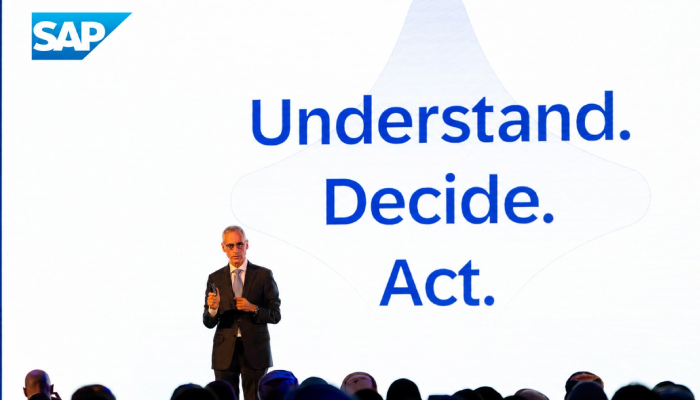
Oman’s next phase of digital transformation will depend on how effectively organisations translate national AI ambitions into measurable business outcomes, with trusted data, cloud technologies and connected enterprise applications emerging as key enablers.
At SAP Connect Day Oman, industry leaders examined how AI can be embedded across business functions to improve decision-making, operational visibility and productivity. The discussions come as Oman advances its Oman Vision 2040 agenda. According to figures cited by the Ministry of Transport, Communications and Information Technology, the Government Digital Transformation Program’s performance rose from 73% at the end of 2024 to 94% at the end of 2025.
SAP outlined its vision for the Autonomous Enterprise, connecting applications, data and AI so that AI agents can operate across business processes with relevant enterprise information and context. Five business-function tracks covered data and IT, finance and spend management, supply chain, human resources, and customer experience.
“ For AI to make a real difference, it needs to understand the business. That means working with trusted enterprise data and within the processes where decisions are made. For companies in Oman, the opportunity is to put AI to work on real business problems, with the right data and context behind it.”
— Sergio Maccotta, Senior Vice President, SAP Middle East and Africa – South
Energy-sector participants highlighted the importance of combining AI capabilities with industry expertise and responsible governance. Waheed Al Hamaid, Head of Enterprise Solutions at Petroleum Development Oman, said AI could help employees anticipate challenges, improve decisions and enhance performance, provided organisations also invest in the skills needed to use it responsibly.
Yaqoob Al Hattali, Head of ICT at Energy Development Oman, emphasised AI’s potential to support scenario planning, operational efficiency and a more resilient energy sector. He stressed that realising these benefits requires clear objectives, responsible governance and collaboration between technology and business leaders.
Abdullah Al Balushi, CIO of Zubair, pointed to a broader opportunity for organisations to rethink how they create value, serve customers and contribute to economic diversification.
The discussions underscore a central challenge for enterprises: AI adoption alone does not guarantee business value. Reliable data, integration with existing processes, workforce readiness and governance will determine whether experimentation translates into sustained results.
With Oman attracting OMR 1.2 billion in communications and information technology investment during 2025, including approximately OMR 65 million in AI, the focus is increasingly shifting towards practical implementation and measurable outcomes.
