

Riverbed study finds 90% of Saudi organisations are meeting or surpassing AI ROI goals, but the next phase of adoption hinges on governance, observability and trusted automation
Saudi Arabia’s enterprise AI journey is entering a new phase. After years of experimentation and pilot projects, organisations across the Kingdom are increasingly focused on scaling AI initiatives, proving business value and laying the groundwork for autonomous IT operations.
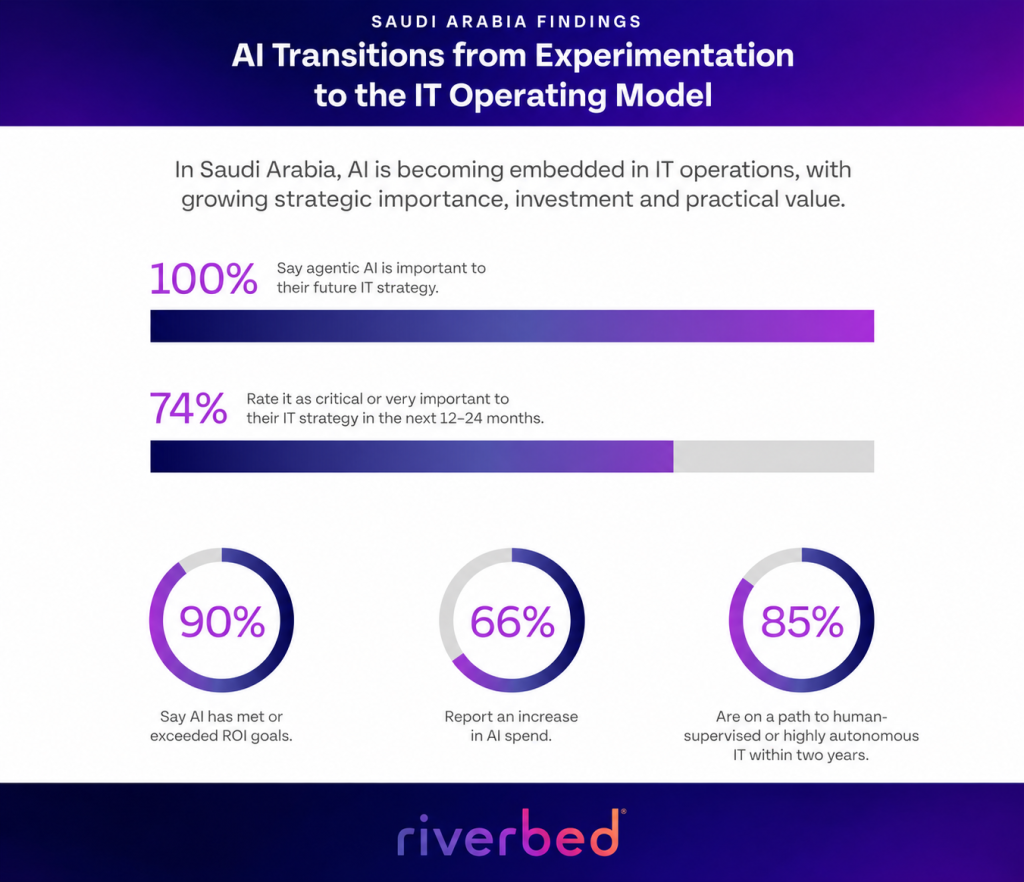
According to Riverbed’s latest Global Survey on the State of Autonomous IT Operations, Saudi organisations are demonstrating both confidence and ambition in their AI strategies. The study reveals that 90% of organisations say their AI initiatives have met or exceeded original return-on-investment goals, while two-thirds increased AI investments during the past year.
The findings suggest that discussions around AI in Saudi Arabia are no longer centred on whether to adopt the technology, but rather how quickly and effectively it can be operationalised across the enterprise.
As organisations advance toward more autonomous operating models, the focus is increasingly shifting to governance, observability, human oversight and the quality of digital experiences delivered to employees.
“The next phase of AI is not simply more automation, but AI that enterprises can understand, trust and govern.”
Jim Gargan, Chief Marketing Officer, Riverbed
Saudi Arabia Emerges as a Confident AI Adopter
The survey highlights a notably high level of confidence among Saudi organisations regarding AI governance and oversight.
More than half (54%) of Saudi respondents describe themselves as extremely confident in their organisation’s ability to govern AI systems and maintain appropriate human oversight, significantly above the global average of 42%.
At the same time, respondents recognise that growing AI adoption will require new operational disciplines. Nearly all respondents (93%) agree that AI assurance, governance and observability will become critical areas of IT management in the years ahead.
The findings illustrate a maturing market where organisations increasingly view governance not as an obstacle to innovation, but as a foundation for sustainable adoption.
“Saudi organisations view governance as an enabler of AI adoption rather than a constraint.”
While confidence is high, caution remains evident. More than three-quarters (77%) of respondents report internal hesitation about allowing AI systems to make operational decisions without human approval, reflecting ongoing concerns around accountability and trust.
Moving Beyond AI Investment to Real Execution
One of the strongest signals emerging from the survey is the shift from experimentation toward execution.
Sixty-six percent of Saudi organisations increased AI spending during the past year, while 85% aim to achieve either human-supervised or highly autonomous IT operations within the next two years.
These figures suggest a growing belief that AI can deliver measurable operational benefits rather than simply serving as a technology innovation initiative.
For many enterprises, AI is becoming an integral part of the IT operating model itself, supporting everything from monitoring and analytics to issue remediation and service delivery.
The challenge now lies in converting investment momentum into scalable operational outcomes.
Organizations that can successfully integrate AI into everyday operations stand to gain advantages in efficiency, resilience and responsiveness.
Employee Experience Becomes the New Success Metric
Interestingly, the study suggests that autonomous IT will not be judged solely on technical performance.
Instead, success will increasingly be measured through employee experience.
Saudi organisations already report stronger-than-average capabilities in using AI to identify and resolve issues before they affect end users. Forty-four percent of respondents say their IT teams are extremely effective at proactively addressing disruptions, compared with 34% globally.
This reflects a broader evolution in enterprise IT priorities.
Historically, IT performance was measured using infrastructure-centric metrics such as uptime, ticket volumes and system availability.
Today, organisations are increasingly focusing on how technology impacts employee productivity and satisfaction.
“The success of autonomous IT should not be measured simply by the number of processes automated. It will increasingly be determined by whether organisations can anticipate problems and prevent disruption.”
The survey found that 96% of respondents expect AI-powered operational intelligence to significantly impact frontline IT and service desk functions over the next two years.
Meanwhile, 36% anticipate a fundamental shift in service delivery, with support models moving away from reactive troubleshooting toward proactive prevention.
Human Oversight Remains Essential
Despite growing confidence in AI capabilities, Saudi organisations are not yet prepared to relinquish human control.
The survey suggests that organisations see autonomous IT as a partnership between humans and machines rather than a complete replacement of human decision-making.
This cautious approach reflects a growing industry consensus that successful AI adoption requires clear governance, transparency and accountability.
As AI systems assume greater responsibility for operational decisions, organisations need visibility into how those decisions are made and confidence that actions can be monitored, validated and, when necessary, overridden.
Maintaining human oversight is therefore becoming a cornerstone of responsible AI deployment.
The Visibility Gap Threatening Autonomous IT
While enthusiasm around AI remains strong, Riverbed’s research identifies a significant obstacle that organisations must address before autonomous IT can fully scale.
Nearly all respondents (95%) consider multi-domain visibility important for AI-driven operations. Yet only 22% currently have fully unified visibility across networks, applications, endpoints and cloud environments.
This visibility gap could become one of the biggest barriers to autonomous operations.
AI systems rely on comprehensive, accurate and contextual data to make effective decisions. Fragmented monitoring environments can limit the quality of insights available to both AI systems and IT teams.
Without end-to-end observability, organizations may struggle to trust automation recommendations or accurately diagnose operational issues.
Tool Consolidation Becomes a Strategic Priority
The survey also reveals growing support for simplifying increasingly complex technology environments.
Ninety-four percent of Saudi respondents believe consolidating IT tools can reduce operational friction, while an equal percentage agree that unified platforms can improve problem resolution and operational efficiency.
These findings reflect a broader enterprise trend toward platform consolidation.
Over the past decade, many organisations have accumulated dozens of monitoring, management and security tools. While each platform may provide value individually, fragmented visibility often creates operational inefficiencies.
For AI-driven operations to scale effectively, organisations increasingly need trusted data sources, consistent telemetry and unified operational views.
“By unifying their data and observability capabilities, Saudi organisations can progress towards autonomous IT while maintaining appropriate human oversight.”
Salman Ali, Senior Manager – Solution Engineering, GCC, Riverbed
A consolidated operational foundation not only improves human decision-making but also provides AI systems with the context necessary to automate tasks safely and effectively.
Vision 2030 Provides Additional Momentum
The survey findings align closely with Saudi Arabia’s broader digital transformation ambitions under Vision 2030.
The Kingdom has invested heavily in digital infrastructure, artificial intelligence initiatives and innovation programs designed to diversify the economy and strengthen global competitiveness.
Against this backdrop, AI is increasingly viewed as a strategic enabler of productivity, operational efficiency and economic growth.
The strong ROI figures reported in the survey suggest that many Saudi organisations are already beginning to realise tangible benefits from these investments.
However, future success will likely depend less on increasing AI deployment and more on creating the governance, visibility and operational foundations necessary to scale responsibly.
The Next Chapter of Enterprise AI
Riverbed’s research paints a picture of an enterprise market moving steadily from AI adoption to AI operationalisation.
The question facing Saudi organisations is no longer whether AI can create value. For most respondents, that question has already been answered.
Instead, the focus is shifting toward trust.
Can AI be governed effectively?
Can decisions be observed and explained?
Can automation operate safely at scale?
Can organizations maintain human oversight while increasing autonomy?
The survey suggests that Saudi enterprises are approaching these questions with both optimism and pragmatism. With 90% reporting successful ROI outcomes and a clear focus on governance, observability and operational discipline, the Kingdom appears positioned to play a leading role in the next stage of enterprise AI adoption.
As autonomous IT moves from aspiration to reality, organizations that combine trusted data, unified visibility and responsible governance will be best placed to turn AI investments into lasting business value.
