

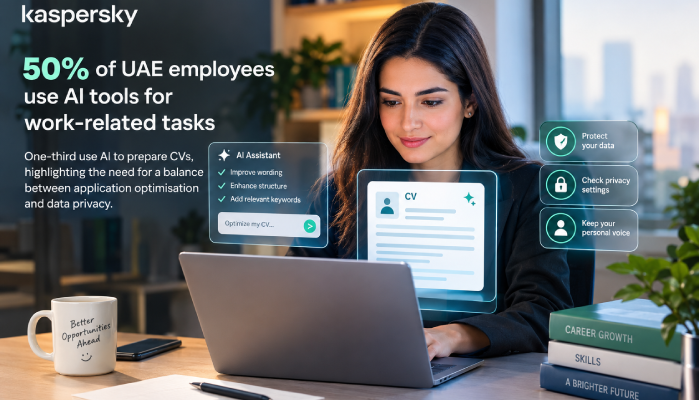
One-third of respondents use AI to prepare CVs, highlighting the need to balance application optimisation with data privacy and authenticity.
Half of employees in the UAE use AI-powered tools for work-related tasks, while one-third use the technology to prepare their CVs, according to a 2026 Kaspersky survey of 1,000 respondents in the country. The findings highlight how AI is becoming part of everyday professional life, including job hunting, while raising concerns about privacy, authenticity and the risks of sharing sensitive information with public AI platforms.
AI tools can help candidates tailor their applications to specific vacancies, improve wording and include relevant keywords to meet the requirements of applicant tracking systems (ATS). However, excessive reliance on AI-generated content can result in generic language, exaggerated claims and applications that fail to reflect a candidate’s actual experience.
Kaspersky recommends treating AI as an editor rather than the author of a CV. Job seekers should first prepare their own draft, identifying their key achievements and relevant skills, before using AI to improve structure, readability and presentation. Candidates should verify every statement and ensure they can substantiate their claims during an interview.
“AI should help job seekers sharpen their applications, not replace their professional voice or compromise their personal data,” says Lama Saqquor, security and privacy expert at Kaspersky.
Data protection is another key concern. Before uploading a CV to a chatbot, applicants should remove personal details such as phone numbers, email addresses, home addresses and confidential company information. They should also review the platform’s privacy policy and data-use settings, including whether submitted information may be used to train AI models.
“AI-powered writing tools are incredibly valuable for structuring and polishing content, but we must remember that public chatbots are essentially data sponges,” said Lama Saqquor, security and privacy expert at Kaspersky. She cautioned that sharing complete career histories, contact details or information protected by non-disclosure agreements with external AI services could expose sensitive data to risks involving storage, processing and future use.
Kaspersky also advises job seekers to remember that AI-assisted CVs may be screened by automated recruitment systems before being reviewed by human recruiters. While candidates can optimise their applications for automated screening, clarity, relevance and credibility remain essential for making a positive impression on hiring managers.
The company recommends using conventional document formats such as DOCX or PDF, maintaining clear headings and consistent dates, and avoiding unnecessarily complex graphics. Applicants should also review their CVs for confidential information and remove personal details that are not required for recruitment.
Beyond CV preparation, Kaspersky advises candidates to check links received through email and messaging platforms, use unique passwords and a password manager, verify employers before sharing personal information, and avoid publishing complete CVs on social networks.
As AI becomes more embedded in recruitment and workplace processes, the findings underscore the importance of using the technology carefully. For job seekers, the challenge is to benefit from AI’s ability to improve applications without sacrificing personal authenticity or control over sensitive information.
