

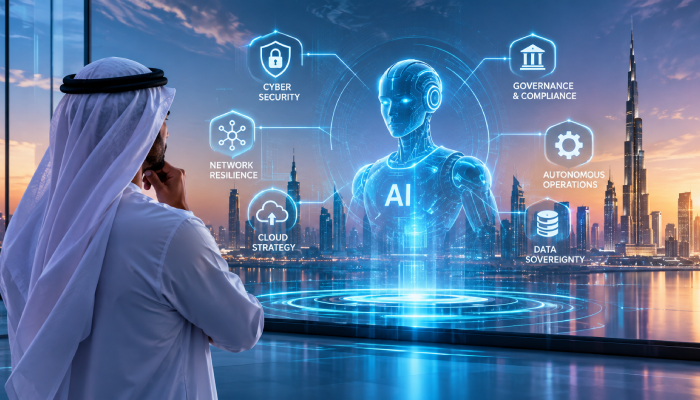
As AI agents evolve from digital assistants into autonomous enterprise workers, 2027 will test the foundations of cybersecurity, network resilience and IT governance. For CIOs and CISOs, the challenge is no longer simply deploying AI, but knowing what their agents can access, whom they serve, how they behave and who is accountable when they act.
When AI stops assisting and starts acting
The enterprise technology landscape is approaching a defining inflection point. Artificial intelligence, which until recently was primarily associated with generating content, answering questions, analysing information and supporting human decision-making, is entering a new phase. AI agents are beginning to operate independently, execute workflows, interact with enterprise applications, access sensitive information and make decisions with increasingly limited human intervention.
This transition from generative AI to agentic AI could fundamentally change how organisations operate. The next generation of digital workforces will not necessarily consist of more employees, but of intelligent software agents working alongside people, communicating with other agents and executing thousands of actions at machine speed.
For enterprises, the productivity proposition is compelling. Agents can automate repetitive processes, improve operational efficiency, accelerate software development, support customer engagement and manage complex IT environments. However, the same autonomy that makes these systems valuable also creates a new dimension of enterprise risk.

“Enterprises will climb quickly” towards greater autonomy.
Brad Rinklin, Chief Marketing Officer, Infoblox
An AI agent with access to corporate applications, employee credentials, customer records and cloud infrastructure is no longer simply another software application. It is an active digital entity with permissions, an identity, a behavioural pattern and the potential to make consequential decisions.
This raises fundamental questions for CIOs and CISOs. How many AI agents are operating across the enterprise? What information can they access? Can they communicate with external systems without authorisation? How can organisations distinguish legitimate machine activity from malicious behaviour? And, perhaps most importantly, who is accountable when an autonomous agent makes a mistake or becomes compromised?
Infoblox’s 2027 technology predictions point to precisely this emerging reality. Its leadership team anticipates that the coming year will see AI agents become deeply embedded in business operations, while cybersecurity teams confront a rapidly expanding attack surface. Network visibility, DNS security, identity management, access governance and autonomous security operations will become increasingly important.
The underlying message is significant: the success of enterprise AI will depend as much on the strength of its infrastructure and security foundations as on the intelligence of the models themselves.
“Regulatory and infrastructure-level security mandates will accelerate in 2027.”
Justin Kappers, Chief Information Officer, Infoblox

For the CIO and CISO community across the Middle East and Africa, this transition deserves particular attention. As organisations accelerate investments in sovereign cloud, AI infrastructure, digital transformation and intelligent automation, the ability to govern autonomous systems will increasingly determine their competitive advantage.
The question is no longer whether enterprises will embrace AI agents. It is whether their technology, security and governance frameworks are ready for a world in which machines increasingly act on behalf of humans.
The enterprise workforce is becoming autonomous
One of the most consequential predictions for 2027 is the emergence of AI agents as a regular part of the enterprise workforce.
The first phase of enterprise AI was largely about augmenting human productivity. Employees used copilots to draft documents, analyse spreadsheets, summarise meetings and generate code. The next phase will involve agents that can independently execute tasks across multiple applications and business systems.
An employee may instruct an agent to organise a procurement exercise, reconcile invoices, investigate a customer complaint or coordinate a software deployment. Rather than simply providing recommendations, the agent will interact with the systems required to complete the assignment.

“Private LLM models which, along with their data, will become the crown jewels of organizations.”
Craig Sanderson, Principal Cybersecurity Strategist, Infoblox
This changes the relationship between employees and enterprise software. Instead of navigating multiple applications, users increasingly communicate their desired outcomes to agents, which then orchestrate the underlying processes.
Frank Ruge, SVP EMEA Direct Sales at Infoblox, believes this shift will be particularly pronounced in 2027.
He describes the evolution in three stages: 2025 was the year of experimentation, 2026 the year of productivity, and 2027 will be the year AI becomes a workforce operating alongside employees.
His prediction that large enterprises could have more software agents operating within their systems than human employees raises an important governance question for business leaders: how many agents does the organisation employ, what can they access, and to whom are they accountable?
For CIOs, this means extending traditional workforce management principles to non-human digital workers. Agents will need identities, defined responsibilities, access permissions, performance monitoring and lifecycle management.
The implications will extend to IT procurement as well. Software platforms will increasingly be evaluated not only on their usability for employees but also on their ability to integrate with autonomous agents through APIs and standardised interfaces.
Applications that cannot support agent-driven workflows may gradually lose their relevance, regardless of how familiar their interfaces are to human users.
This is a profound shift in enterprise architecture. The organisation of tomorrow will need to manage a hybrid workforce comprising people, applications, automated processes and autonomous agents. Its operational efficiency will depend on how effectively these components collaborate.
“Autonomous AI agents could execute thousands of actions a day.”
Krupa Srivatsan, Senior Director, Product Marketing, Infoblox

The visibility crisis: Governing agents before they govern the enterprise
The expansion of agentic AI is creating a governance problem that many organisations are not yet prepared to address.
Enterprises have invested considerable effort in managing human identities, application access, privileged accounts and endpoints. However, the proliferation of autonomous agents introduces a different category of digital identity.
Agents may be created by employees, embedded within enterprise applications, introduced through third-party platforms or connected to external services. Some may operate with official IT approval, while others could emerge without the knowledge of security teams.
This is the emerging challenge of shadow AI agents.
Scott Harrell, President and Chief Executive Officer of Infoblox, warns that enterprises are deploying agents faster than they are developing the governance mechanisms required to manage them.
The concern is not merely how many agents exist, but whether security teams understand what those agents can reach, which systems they interact with, what information they process and how they behave.
An unmanaged agent can become a new entry point into enterprise infrastructure. If compromised, it may provide attackers with access to information and applications beyond the permissions of an individual employee.

“The rigid organizational boundaries between network, security and cloud teams will continue to erode.”
Scott Harrell, President & CEO, Infoblox
The traditional approach of managing access through predefined control points may prove insufficient when agents dynamically interact with multiple systems.
CIOs and CISOs will therefore need an enterprise-wide inventory of autonomous agents, including their ownership, purpose, identity, permissions, connections and operational status.
This inventory should become part of the broader IT asset and identity management framework rather than remaining an isolated AI governance exercise.
The challenge is also organisational. AI governance cannot be confined to innovation teams or technology departments. Business units deploying agents must share responsibility for their behaviour and outcomes.
The strategic priority is to establish visibility before autonomy scales beyond the organisation’s ability to control it.
Zero Trust faces a new paradox: Agents need access to deliver value
Zero Trust has become a central principle of enterprise cybersecurity. Its fundamental philosophy is straightforward: no user, device or application should automatically be trusted, and access should be restricted to the minimum required.
However, agentic AI introduces a difficult contradiction.
An AI agent’s effectiveness frequently depends on the breadth of information available to it. A coding agent may perform better when it can access customer feedback, product documentation and application code. A business development agent may need access to customer records, emails and commercial information. A personal productivity agent may require access to calendars, documents and communication platforms.
“DNS resilience as foundational, not optional.”
Cricket Liu, EVP and Chief Evangelist, Infoblox

The more context an agent receives, the more useful it can become.
But broader access also increases the potential damage if that agent is compromised.
Mukesh Gupta, Chief Product Officer at Infoblox, identifies this as one of the central security challenges of the agentic era.
The conventional principle of least privilege will come under increasing pressure as organisations connect applications and information repositories to improve agent performance.
This does not mean Zero Trust becomes irrelevant. Rather, it needs to evolve beyond static permissions towards continuous monitoring of how access is actually used.
Security teams will need to understand which agent accessed which information, what actions it performed, whether the activity was consistent with its intended purpose and where the information subsequently travelled.
This requires a combination of identity governance, contextual access controls, behavioural analytics and network-level monitoring.
The challenge becomes even more complicated when agents operate across personal and professional environments.

“The most valuable target in an organization won’t be the employee. It will be the employee’s agent.”
Mukesh Gupta, Chief Product Officer, Infoblox
Employees may bring their own AI agents to work, creating a situation similar to the earlier Bring Your Own Device phenomenon. These agents may already have access to personal emails, financial information, calendars and other sensitive data.
Banning such agents outright could encourage shadow usage. A more practical strategy would be to provide approved enterprise pathways, clearly defined permissions and boundaries separating personal and corporate information.
The message for CISOs is clear: access governance must become dynamic, contextual and behaviour-driven.
Business Agent Compromise: The next evolution of social engineering
Cybercriminals have traditionally targeted people through phishing emails, fraudulent websites, malicious attachments and impersonation campaigns. Agentic AI could change the preferred target.
As agents gain access to email accounts, calendars, financial services, corporate documents and payment systems, they will become attractive targets for attackers.
Mukesh Gupta predicts the emergence of agent-directed social engineering, in which malicious emails, invitations and websites are designed specifically to manipulate AI agents rather than human users.
This creates the possibility of Business Agent Compromise, an evolution of traditional Business Email Compromise.
Consider an autonomous agent assigned to process invoices. It receives a seemingly legitimate email containing payment instructions. The message may include hidden or indirect instructions designed to influence the agent’s decision-making.
If the agent trusts the information and has sufficient payment permissions, it could initiate a fraudulent transaction without a human employee ever opening the message.
“The real story for defenders in 2027 may not be a brand-new kind of attack but how much faster and cheaper the familiar ones have become to launch.”
Dr. Renée Burton, Head of Infoblox Threat Intel

The same principle could apply to procurement, insurance claims, travel bookings, customer support and other automated workflows.
Indirect prompt injection is particularly concerning because malicious instructions may be embedded within documents, web pages or other content that an agent is asked to process.
The security challenge is therefore no longer limited to protecting users from deceptive messages. Organisations must also protect agents from manipulated information.
This requires stronger validation of instructions, restrictions on sensitive actions, independent verification of transactions and monitoring of outbound network communications.
The point at which an agent attempts to connect to an unfamiliar or malicious destination may become an important opportunity to interrupt an attack.
For CISOs, the implications are substantial. Security awareness programmes must evolve to include machine-oriented threats, while identity and access management systems must recognise agents as potential victims as well as potential threat actors.

“Security teams won’t be able to hold the line on minimum access alone.”
Mukesh Gupta, Chief Product Officer, Infoblox
DNS moves from network plumbing to a strategic security layer
One of the most important themes emerging from Infoblox’s predictions is the growing strategic significance of the Domain Name System (DNS).
DNS has traditionally been regarded as a fundamental network service that translates domain names into IP addresses. Although essential to connectivity, it has not always received the same strategic attention as firewalls, endpoint security or identity management.
That perception may change significantly as agentic AI becomes mainstream.
Every agent operating across the internet and enterprise infrastructure needs to communicate with services, applications and external systems. DNS is therefore a critical part of the communication infrastructure underpinning autonomous operations.
Mukesh Gupta argues that agents may increasingly use DNS as a path to reach external systems, particularly when organisations restrict other outbound communication channels.
“Every ungoverned agent is a new entry point attackers can exploit before anyone notices.”
Scott Harrell, President & CEO, Infoblox

Some agents may do so as part of legitimate operations, while others may be instructed to bypass established controls.
This creates an opportunity for DNS-layer monitoring to identify suspicious communication patterns, prevent connections to malicious domains and provide visibility into agent behaviour.
However, DNS should not be viewed as a standalone solution.
Henrik Smith, Chief Information Security Officer at Infoblox, cautions against over-reliance on any single security control point, including DNS.
His argument is important because sophisticated attackers will attempt to identify alternative routes when a particular communication channel is blocked.
A resilient security architecture must therefore map all possible egress paths and apply appropriate controls across the infrastructure.
The broader issue is that DNS security should become part of a layered enterprise defence strategy rather than being treated as a specialised network function.
Cricket Liu, Executive Vice President and Chief Evangelist at Infoblox, takes this argument further by positioning DNS resilience as an enabler of AI performance.
AI workloads require fast, reliable and secure access to data. Even highly sophisticated models can deliver disappointing results if the underlying network infrastructure is unreliable.
DNS disruptions, configuration errors and performance bottlenecks can undermine AI services and interrupt automated workflows.
This represents a shift in the investment conversation. DNS modernisation may increasingly move from routine IT maintenance budgets into strategic AI infrastructure planning.
For CIOs, the lesson is that AI readiness cannot be measured only through GPU capacity, model performance or cloud investment. The reliability of the infrastructure connecting these resources is equally important.

“AI stops being a tool employees use and becomes a workforce that operates alongside them.”
Frank Ruge, SVP EMEA Direct Sales, Infoblox
The new network challenge: From outages to invisible brownouts
As AI factories, neoclouds and multi-cloud environments expand, enterprise network architecture will become increasingly complex.
Traditional network monitoring has generally focused on identifying outages, congestion and other clearly visible infrastructure problems. However, agentic operations may be more vulnerable to subtle performance degradation.
Scott Harrell predicts that enterprises will increasingly experience what he describes as network brownouts.
These are intermittent problems involving latency, bandwidth contention and other performance issues that may not result in complete service failure but can significantly affect AI and agent performance.
An agent that depends on continuous interaction with several applications may become unreliable when one network connection experiences intermittent degradation.
The difficulty is that such problems may be difficult to reproduce and diagnose. By the time an IT team investigates a reported issue, the network may have returned to normal.
This makes proactive monitoring essential.
Network teams will need to understand infrastructure conditions in real time, correlate performance indicators and identify how network behaviour affects agent-driven processes.
The operational model will also change.
Harrell predicts that the traditional boundaries between network, security and cloud teams will continue to erode. The emergence of autonomous systems will demand greater collaboration across these functions.
A network problem affecting an AI agent may simultaneously become an application availability issue, a business continuity concern and a security monitoring challenge.
Organisations that retain rigid operational silos may struggle to respond at the speed required.
The rise of the full-stack IT professional may therefore become an important organisational trend, with technology teams expected to understand interconnected infrastructure rather than operate within narrowly defined technical domains.
AI-powered cybercrime: Familiar attacks, industrial-scale execution
While the prospect of entirely new cyberattack techniques attracts considerable attention, the more immediate danger may come from the industrialisation of existing criminal methods.
Dr. Renée Burton, Head of Infoblox Threat Intel, argues that AI will give threat actors greater automation, speed and complexity, without necessarily requiring them to invent fundamentally new attack methods.
Phishing, malware distribution, impersonation and online scams remain effective because they exploit established human weaknesses.
AI makes these techniques cheaper and easier to customise.
Cybercriminals who previously depended on commercially available phishing kits or underground services can increasingly use AI tools to develop their own campaigns.
AI-generated phishing kits can be rapidly modified to impersonate different brands, languages and organisations. Deepfake videos can make fraudulent investment schemes and impersonation attempts more convincing.
The growing use of AI-generated content also creates challenges for traditional detection methods.
Lookalike domains are another emerging concern. AI can generate large batches of deceptive domains across multiple languages, making it harder to identify malicious activity through conventional pattern matching.
Security teams will need to move towards behavioural and contextual detection rather than relying exclusively on known signatures.
This has direct implications for smaller enterprises across the Middle East and Africa.
AI-assisted attacks can lower the technical barriers that previously prevented less sophisticated criminal groups from launching highly personalised campaigns.
As a result, organisations that historically considered themselves unlikely targets may face increasingly sophisticated threats.
The defensive response must include continuous threat intelligence, domain monitoring, email security, DNS-layer protection and stronger employee awareness.
The autonomous SOC: Can machines defend against machines?
The growth of agentic activity will create a volume of security events that traditional human-led Security Operations Centres may struggle to process.
An autonomous agent could execute hundreds or thousands of actions in a day. Each action may generate network requests, authentication events, application interactions and security alerts.
When multiplied across hundreds or thousands of agents, the volume could overwhelm existing monitoring and incident response capabilities.
Krupa Srivatsan, Senior Director, Product Marketing at Infoblox, highlights the scale of this challenge.
She predicts that autonomous agents could execute thousands of actions daily compared with the relatively limited number of actions performed by a typical human user.
The resulting alert volume could force SOC teams to rethink their operating models.
Traditional security operations rely heavily on analysts reviewing alerts, investigating suspicious activity and deciding what action to take.
This model may not be sufficiently fast when attacks and defensive responses unfold at machine speed.
Scott Harrell believes security operations centres will increasingly need to become agentic themselves.
Autonomous systems could monitor suspicious activity, adjust DNS policies, isolate compromised agents and initiate predefined defensive actions.
However, the transition introduces a critical governance question: how much authority should an autonomous security system possess?
For example, an agent authorised to block a suspicious domain may be useful during a routine incident. But automatically shutting down network access across a business could create serious operational consequences.
Organisations will therefore need clearly defined guardrails specifying which actions can be executed autonomously, which require approval and which must remain under human control.
The precision of containment will also matter.
Mukesh Gupta predicts that the agent kill switch will evolve from a general shutdown capability into a more targeted control capable of isolating an individual rogue agent without disrupting legitimate business operations.
The future SOC will therefore be a hybrid operating environment in which human analysts supervise automated detection, investigation and response systems.
The measure of maturity will not simply be the number of alerts processed but the speed, accuracy and accountability of incident containment.
Agentic Denial of Service: When the cost of defence becomes an attack vector
Among the more unusual predictions for 2027 is the emergence of Agentic Denial of Service.
Scott Harrell believes attackers may exploit the economics of AI security operations by deliberately exhausting the resources consumed by defensive systems.
Many enterprise AI and security tools operate on consumption-based commercial models. Their usage can be measured through tokens, API calls and processing requirements.
An attacker could generate large volumes of activity designed to force a defensive system to consume substantial resources.
This creates a different kind of denial-of-service scenario.
Instead of simply overwhelming a network or application, attackers could target the economic and operational capacity of the security infrastructure itself.
The result could be escalating costs, reduced detection capabilities or disruption of automated security operations.
Brad Rinklin, Chief Marketing Officer at Infoblox, also expects Agentic Denial of Service to become an established category of concern as autonomous systems are weaponised against other agents and agentic infrastructure.
This highlights a vulnerability that extends beyond conventional infrastructure capacity.
Enterprises must consider the cost of operating AI-driven security systems, the limits of automated processing and the possibility that adversaries could deliberately manipulate consumption.
Security architecture will need safeguards against excessive requests, abnormal agent activity and resource exhaustion.
Digital sovereignty and the rise of private AI infrastructure
The growing dependence on external AI platforms is creating strategic questions around data ownership, sovereignty and control.
Enterprises increasingly recognise that sensitive business information cannot always be processed through public AI services without careful consideration of privacy, security and regulatory obligations.
Craig Sanderson, Principal Cybersecurity Strategist at Infoblox, expects concerns around public AI model quality, data loss and control of critical information to encourage organisations to develop private large language models.
These private environments may become among the most valuable digital assets an organisation possesses.
They will contain proprietary information, specialised models, enterprise knowledge and the agentic systems that operate on top of them.
Protecting these assets will require more than conventional application security.
Enterprises will need to secure model access, agent identities, data pipelines, prompts and the communication channels connecting AI systems to external infrastructure.
Sanderson also points to the emergence of AI-related threat marketplaces involving stolen prompts, AI assets and LLM jacking.
These developments reinforce the need for security standards and enterprise-grade solutions capable of protecting private AI deployments.
Neocloud infrastructure may become an important part of this environment, offering specialised infrastructure for organisations seeking greater control over AI workloads.
For governments and regulated industries across the MEA region, this trend intersects with digital sovereignty strategies.
Financial institutions, healthcare providers, public-sector organisations, energy companies and telecommunications operators must increasingly consider where their data is processed, which jurisdictions govern it and who can access their AI systems.
The strategic opportunity for the region is to build AI ecosystems that combine innovation with sovereignty, resilience and trusted infrastructure.
Regulatory pressure will reshape enterprise AI governance
The rapid growth of autonomous systems is also likely to intensify regulatory scrutiny.
As agents begin making decisions and executing transactions, regulators will need greater transparency into how these systems operate.
Justin Kappers, Chief Information Officer at Infoblox, expects regulatory and infrastructure-level security mandates to accelerate in 2027.
He highlights the growing importance of protective DNS and security-by-design requirements for cloud and IoT environments, alongside the compliance challenges created by digital sovereignty legislation.
For multinational enterprises operating across several jurisdictions, regulatory complexity will increase.
The European regulatory environment provides an indication of the direction of travel, with frameworks such as the EU AI Act, NIS2 and DORA creating requirements that affect AI governance, operational resilience and cybersecurity.
Frank Ruge similarly expects enterprises to face growing demands for demonstrable visibility into their AI agents and models.
Maintaining an inventory of agents, their operating environments, their permissions and their activities will become increasingly important.
Compliance will need to move beyond periodic documentation exercises towards continuous monitoring and auditable records.
CIOs will have to work closely with CISOs, legal teams, risk officers and business leaders to establish accountability for autonomous operations.
For enterprises in the MEA region, the challenge will be to align global AI governance practices with the regulatory requirements of individual markets.
Organisations operating across the UAE, Saudi Arabia and other regional jurisdictions will need to consider data residency, sovereignty, cybersecurity and sector-specific compliance obligations as part of their AI strategies.
A tiered autonomy model: Not every agent should operate independently
One of the important strategic questions facing enterprise leaders is how much autonomy to grant AI agents.
Not every business process requires the same degree of independence.
An agent that summarises documents or organises internal information presents a different risk from one authorised to initiate payments, modify production systems or access sensitive customer records.
Brad Rinklin believes the industry will move towards a tiered framework for autonomous agents.
Under this approach, organisations could distinguish between low-risk personalisation agents and systems operating within mission-critical environments.
The distinction would allow enterprises to adopt AI progressively rather than treating autonomy as an all-or-nothing decision.
Low-risk agents could be allowed to perform routine tasks independently, while more sensitive activities would require human approval or additional verification.
This approach is particularly relevant for industries such as banking, healthcare, energy and government, where an incorrect automated decision could have significant consequences.
Organisations will need to define autonomy levels, escalation mechanisms, approval requirements and rollback capabilities.
Frank Ruge also anticipates that autonomy levels similar to those used in the automotive industry may begin appearing in enterprise technology procurement.
Customers will want to know which functions operate independently, which require approval and which remain manual.
The objective should not be to eliminate human oversight, but to apply it intelligently where the consequences of failure are greatest.
The CIO-CISO partnership becomes the foundation of the agentic enterprise
The arrival of autonomous AI will challenge traditional organisational responsibilities.
Historically, CIOs have focused on technology strategy, infrastructure, application modernisation and business enablement, while CISOs have concentrated on cybersecurity, risk management and compliance.
Agentic AI brings these responsibilities together.
An AI agent’s performance depends on infrastructure reliability, identity management, network connectivity, application integration, data governance and security controls.
A weakness in any one of these areas can undermine the entire system.
Scott Harrell’s prediction about the emergence of full-stack IT professionals reflects this broader convergence.
Technology leaders will need to break down operational silos and create closer coordination between network, cloud, security and application teams.
Justin Kappers also sees AI-enabled automation changing how IT teams manage risk and reliability.
Agents capable of patching vulnerabilities, resolving outages and automating routine infrastructure operations could free IT professionals to focus on resilience planning, governance and strategic initiatives.
However, automation will not eliminate accountability.
The CIO must ensure that autonomous systems deliver measurable business value, integrate with enterprise architecture and operate reliably.
The CISO must ensure that those systems are identifiable, monitored, appropriately authorised and protected against manipulation.
Both must work together to define acceptable levels of autonomy and establish mechanisms for intervention when systems behave unexpectedly.
The board will also need a new set of performance indicators.
Traditional measures such as system availability, incident numbers and ticket resolution times will remain relevant, but they will need to be supplemented by metrics covering agent inventory, privileged access, autonomous incident containment, model risk and AI-related operational resilience.
Frank Ruge expects IT organisations to operate with greater leverage, as engineers supervise fleets of autonomous agents across network, cloud and security environments.
The measure of a successful IT department may increasingly become how much infrastructure each professional can safely manage, rather than simply how many people it employs.
Conclusion: The future belongs to enterprises that can trust their agents
The transition towards agentic AI is not simply another phase in the evolution of enterprise software. It represents a fundamental change in how work is executed, how decisions are made and how digital infrastructure is managed.
The opportunity is enormous. Autonomous agents can improve productivity, accelerate innovation, reduce operational overheads and enable enterprises to operate at a scale that traditional human-led processes cannot easily achieve.
But autonomy without visibility is a liability. Intelligence without governance creates risk. And automation without resilient infrastructure can turn productivity initiatives into operational vulnerabilities.
Infoblox’s predictions for 2027 highlight a clear strategic direction. Enterprises will need to move beyond conventional cybersecurity thinking and develop an integrated approach to agent identity, access governance, behavioural monitoring, DNS security, network resilience and autonomous incident response.
For CIOs, the priority will be to build infrastructure that can support machine-speed operations without compromising reliability.
For CISOs, the challenge will be to secure a growing population of non-human identities, monitor agent behaviour and ensure that automated systems cannot become convenient pathways for attackers.
For boards, the question will increasingly be one of accountability: who controls the agents, what authority do they possess and how does the organisation know they are acting in its interests?
The Middle East and Africa region has an opportunity to embrace this transition as part of its wider digital transformation and AI ambitions. But the organisations that benefit most will not necessarily be those deploying the largest number of agents or investing the most in computing infrastructure.
They will be the enterprises that understand their digital environment, govern their autonomous workforce and build security into every layer of their operations.
The defining competitive advantage of the agentic era will not simply be artificial intelligence. It will be trusted autonomy.
