

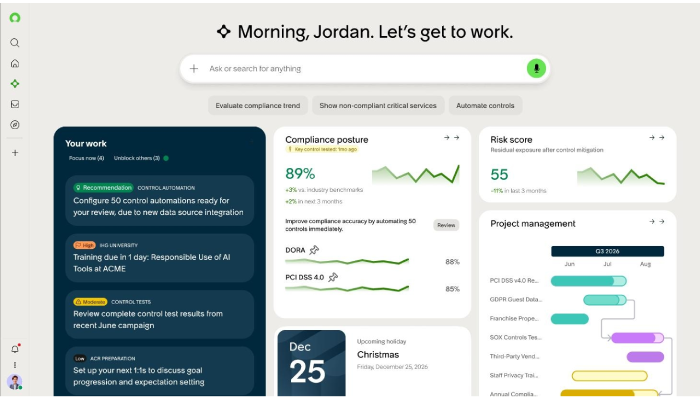
New capabilities will use AI agents to monitor controls across connected cloud, identity, SaaS and on-premises systems, with general availability expected in Q1 2027.
As enterprises adopt AI and expand their digital infrastructure, periodic compliance checks are struggling to keep pace with continuously changing cyber and operational risks. ServiceNow is addressing this gap with agentic AI capabilities for continuous control monitoring in its Integrated Risk Management (IRM) platform, designed to identify control failures, interpret their impact and initiate remediation across connected enterprise systems.
Announced on November 26, 2026, the capability extends monitoring beyond the ServiceNow platform through more than 100 pre-built integrations covering cloud, containers, identity, AI, SaaS, on-premises and business applications. It also supports monitoring of connected operational technology, IoT and medical devices.
AI agents will configure compliance checks, interpret results and identify controls that have failed or are drifting from expected performance. When a failure occurs, the platform can flag the issue, open a ticket and initiate automated remediation within defined policies. The aim is to reduce the time between detecting a control weakness and resolving it.
“Agentic continuous control monitoring watches every control an organization has connected and explains what a failure is,” said Vasant Balasubramanian, Group Vice President and GM of Risk, Super Intelligence Control Tower, and ESG at ServiceNow. He said the approach gives risk and audit leaders assurance that keeps pace with business operations.
“ServiceNow is closing the gap between what an organization’s last audit showed and what’s true today by making assurance a live signal across the enterprise.”
— Vasant Balasubramanian, Group Vice President and GM of Risk, Super Intelligence Control Tower, and ESG, ServiceNow
From periodic audits to continuous assurance
The platform brings control monitoring across multiple enterprise systems into a central view. Its Control Orchestration capability maps controls to the tools that enforce them, while Compliance Graph connects signals across systems to identify areas of risk. Access Graph, part of ServiceNow’s Context Engine, adds visibility into human, machine and AI agent access, including whether permissions are revoked when employees or agents leave.
Unified control mapping is another feature. A control tested against one framework can be mapped to equivalent requirements across standards such as SOX, PCI-DSS, ISO 27001, HIPAA and the EU AI Act. This is intended to reduce duplicate testing and allow evidence from a common control repository to support multiple compliance requirements.
The system is designed for all three lines of defence: business teams can monitor their own controls, risk and compliance functions can track failures and remediation, and internal audit teams can access test results with supporting evidence.
IDC Research Director Philip D. Harris described the approach as a closed-loop process in which an agent interprets a control failure, initiates remediation and verifies the fix, rather than simply presenting compliance dashboards.
ServiceNow expects general availability of Agentic AI for Continuous Controls Monitoring in Q1 2027. The company will showcase the capabilities at GITEX Global, taking place December 8–11 in Dubai, at booth H13.C20 alongside six partners.
