


New TruConfidence engine combines AI-driven remediation intelligence, automated rollouts and system-health monitoring to help enterprises reduce cyber risk without disrupting operations.
Qualys has launched TruRisk Eliminate 2.0 with TruConfidence, an AI-powered remediation intelligence and orchestration engine designed to help enterprises address cyber exposures at machine speed while maintaining business continuity.
Announced on October 20, 2026, the offering supports Qualys’ vision for Autonomous RemOps, an approach that combines risk assessment, remediation and operational safeguards to accelerate vulnerability management as AI speeds up both vulnerability discovery and exploitation.
Qualys said its experience spans half a billion patch deployments, with less than 0.1% requiring rollback and 40% deployed autonomously. The new platform brings together capabilities including AI-powered Patch Reliability Score, wave-based remediation orchestrated by Agent Sara, peer-to-peer distribution and compensating controls informed by real-world deployment data.
“Autonomous exploitation requires an equally automated remediation, but organizations’ hesitation isn’t about automation, it’s a lack of confidence that it won’t cause an outage.” — Sumedh Thakar, President and CEO, Qualys
The approach aims to address a growing disconnect between security and IT operations. Traditional vulnerability management often relies on manual decisions, tickets and hand-offs, while attackers increasingly operate at machine speed. Enterprises must now determine not only which vulnerabilities to fix, but also how to remediate them without creating service outages or duplicating protections already provided by existing security controls.
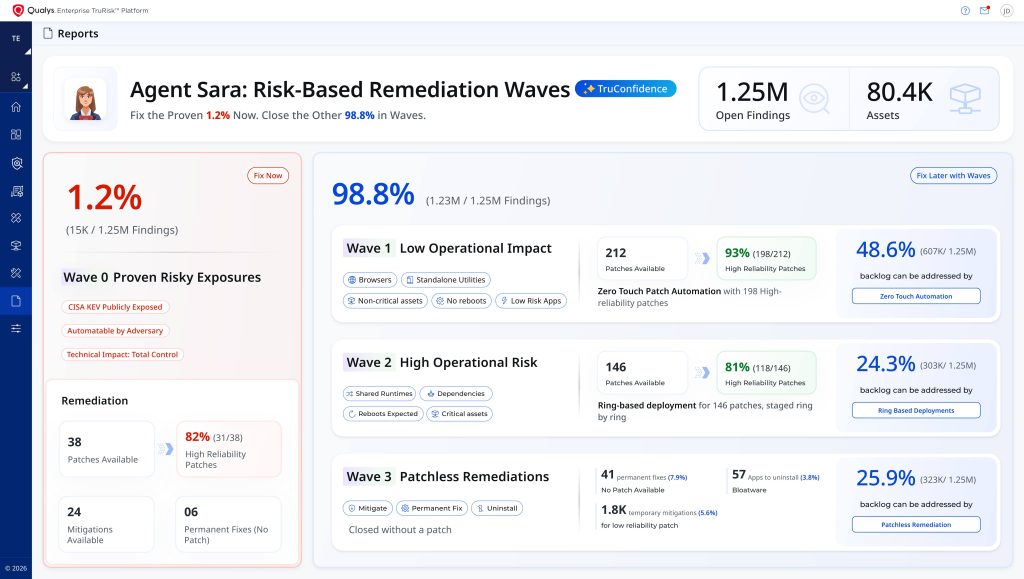
TruRisk Eliminate extends remediation across hybrid environments, including perimeter devices, cloud infrastructure and applications. Depending on the exposure, organisations can patch, apply mitigations, uninstall software, isolate assets or deploy custom fixes. Qualys scanners and existing security and IT integrations can also support remediation for assets that cannot run an agent.
The TruConfidence engine evaluates existing controls before recommending additional action. Where patching is not immediately practical, third-party mitigation intelligence can identify compensating measures and apply them through customers’ existing security tools, reducing exposure while a permanent fix is planned.
Operational safeguards are another key component. Integrations with partners such as Dynatrace allow the platform to monitor system health after remediation, including CPU spikes, memory issues and other conditions that could affect services. If a fix fails, AI-powered Patch Failure Analysis identifies potential causes and recommends corrective action, including rollback where appropriate.
“Qualys TruRisk Eliminate gives security a viable path to drive remediation at machine speed, with patch reliability scoring, progressive rollouts, and patchless mitigation that reduce the risk of disrupting operations,” said Jon Nelson, Principal Advisory Director in the Security & Privacy practice at Info-Tech Research Group.
Qualys said TruRisk Eliminate 2.0 with TruConfidence is now generally available, with a free upgrade for existing TruRisk Eliminate customers. The launch reflects a broader shift in enterprise security: moving beyond vulnerability identification and patch deployment towards automated remediation that accounts for business risk, existing controls and service reliability.
