


Disruptions across critical EU systems highlight how AI is accelerating cyber warfare and forcing organizations to rethink resilience, recovery, and data security
The reported cyberattack on the European Commission is more than another high-profile security breach. It may become one of the defining examples of how artificial intelligence is fundamentally reshaping the cyber threat landscape. According to officials familiar with the matter, hackers allegedly leveraged ARTEX, an AI-powered vulnerability discovery tool, to identify weaknesses within the Commission’s IT infrastructure, triggering disruptions that reportedly lasted more than ten days and affecting critical internal systems.
While authorities continue to investigate the full scope of the incident, early reports suggest potential exposure of personal employee information, operational disruptions across key administrative platforms, and emergency intervention at the highest levels of European governance. The incident serves as a stark reminder that organizations worldwide are entering a new phase of cyber risk, one where attackers increasingly use AI to automate discovery, accelerate exploitation, and scale attacks with unprecedented speed.
What Happened?
According to information disclosed by EU officials, the attack targeted multiple European Commission systems and forced several applications offline as a precautionary measure. The Commission’s HR platform, Sysper, which manages payslips, timesheets and leave requests, reportedly suffered disruptions, while MyPMO, the medical reimbursement system, was also affected. Translation services experienced outages, creating operational challenges across departments.
Investigators are still working to determine whether employee data was compromised and, if so, to what extent. This uncertainty has complicated communication efforts, with officials reportedly reluctant to provide definitive statements until the investigation produces clear findings.
The seriousness of the attack prompted discussions within the Commission’s Corporate Management Board and briefings at the College of Commissioners level. Such escalation demonstrates how cybersecurity incidents have evolved from technical issues handled by IT departments into strategic crises demanding executive and governmental attention.
The Rise of AI-Powered Offensive Cyber Capabilities
The most significant aspect of the incident is the reported use of ARTEX, a publicly available AI-enabled vulnerability identification tool. Although such technologies are frequently developed for legitimate cybersecurity purposes, including penetration testing and security assessments, they can also be weaponized by threat actors.
Traditionally, attackers spent considerable time manually scanning networks, analyzing applications, and searching for exploitable weaknesses. Artificial intelligence dramatically shortens that process. Modern AI systems can rapidly evaluate thousands of assets, correlate known vulnerabilities, prioritize attack pathways and identify potential weaknesses at a speed that human analysts cannot match.
The European Commission attack illustrates a growing concern among security professionals that AI is becoming a force multiplier for cybercriminals and nation-state actors alike. Just as businesses have embraced AI to improve productivity, attackers are increasingly adopting it to improve the efficiency and effectiveness of their operations.
The result is a cybersecurity environment where attacks can be launched faster, adapted more dynamically and executed at greater scale than ever before.
Why Speed Changes Everything
One of the defining characteristics of AI-driven cyber threats is speed. Organizations that previously had days or weeks to identify suspicious activity may now have only hours, or even minutes, to respond.
Michael Cade, Field CTO at Veeam Software, believes this shift requires a fundamental change in defensive thinking.
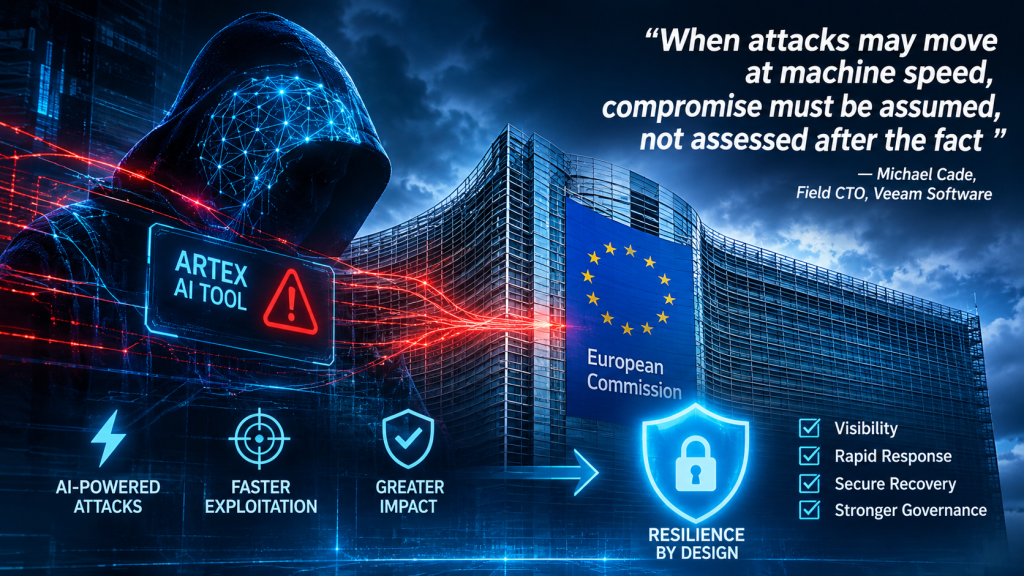
“The incidents of the past week, including the alleged attack on the European Commission today, are a stark reminder of how quickly AI is changing the speed and scale of cyber risk. When attacks may move at machine speed, compromise must be assumed, not assessed after the fact.”
This statement reflects a growing industry consensus that traditional cybersecurity models are no longer sufficient. The longstanding objective of keeping adversaries out at all costs is being replaced by a resilience-focused approach that assumes breaches will occur and prioritizes rapid containment and recovery.
Organizations must therefore prepare not only to prevent attacks but also to operate effectively when prevention fails.
“When attacks may move at machine speed, compromise must be assumed, not assessed after the fact.”
Michael Cade, Field CTO, Veeam Software
The Visibility Challenge
One of the most difficult questions organizations face after a cyberattack is determining what has actually been compromised.
Large enterprises and government agencies often manage thousands of applications, databases, cloud services, endpoints and backup repositories. Without comprehensive data visibility, security teams can struggle to answer critical questions about the extent of exposure.
Cade highlights this challenge as one of the most significant barriers to effective incident response.
“The real challenge for most organisations is what happens next. Without record-level knowledge of their data, what they hold, where it resides, and who and what can access it, they can be left in limbo, trying to work out what might have been compromised when their attention should be on recovery.”
The challenge is especially relevant for public-sector organizations, which often operate vast and highly interconnected digital environments. Understanding data locations, ownership structures and access permissions has become essential for determining impact and prioritizing recovery efforts.
As cyberattacks become faster and more sophisticated, data intelligence is emerging as a foundational component of cyber resilience.
Recovery Alone Is Not Enough
One of the most important lessons from recent cyber incidents is that successful recovery involves far more than restoring systems from backup.
In traditional disaster recovery scenarios, restoring applications and data was often considered the final step. Cyber incidents demand a more comprehensive approach.
If attackers gained access through an unpatched vulnerability or configuration weakness, simply restoring systems can inadvertently recreate the same conditions that enabled the breach in the first place.
Cade warns against this common mistake:
“But recovery alone is not enough. Where an attack has exploited a vulnerability, simply restoring data and systems brings that same weakness back with them, leaving the door open to a repeat attack.”
This observation highlights the growing importance of cyber recovery strategies that combine restoration with remediation. Organizations must ensure that vulnerabilities are identified, patched and validated before restored systems return to production.
Modern recovery playbooks increasingly include threat hunting, forensic reviews, patch deployment, identity verification and configuration hardening as standard recovery components.
Cybersecurity Becomes a Boardroom Issue
The European Commission incident reflects a broader shift taking place across industries. Cybersecurity is no longer solely the responsibility of technology teams.
Today’s cyberattacks can disrupt operations, halt revenue-generating activities, impact regulatory compliance and erode public trust. Consequently, cybersecurity discussions increasingly take place at boardroom and cabinet levels rather than exclusively within security operations centers.
The Commission’s decision to convene senior leadership meetings demonstrates how cyber resilience has become a governance issue. Similar patterns can be observed globally as governments, regulators and corporate boards recognize cybersecurity as an operational and strategic imperative.
This evolution mirrors growing regulatory pressure worldwide, including frameworks such as the EU’s NIS2 Directive, the Digital Operational Resilience Act (DORA), and increasingly stringent reporting requirements for cybersecurity incidents.
AI Is Fueling a Digital Arms Race
Artificial intelligence is rapidly becoming a core technology on both sides of the cybersecurity battlefield.
Defenders are deploying AI for threat detection, anomaly analysis, security automation and incident response. At the same time, attackers are using similar technologies to generate phishing campaigns, automate reconnaissance, identify vulnerabilities and accelerate intrusion attempts.
This creates an escalating arms race where both attackers and defenders are becoming more capable, but not necessarily at the same pace.
The challenge for enterprises is particularly acute because defenders must protect every critical system while attackers need only a single successful entry point. As AI increases attacker efficiency, organizations must strengthen resilience, visibility and recovery capabilities to maintain an effective defense posture.
Lessons for Global Organizations
The European Commission attack offers several critical lessons for organizations across both public and private sectors:
- Assume breaches will happen and develop incident response plans accordingly.
- Maintain detailed visibility into critical data assets and access controls.
- Conduct regular vulnerability assessments and patch management exercises.
- Test cyber recovery and business continuity plans through realistic simulations.
- Secure backup environments against compromise or encryption.
- Integrate remediation, patching and validation into recovery procedures.
- Elevate cybersecurity governance to executive leadership and board-level oversight.
- Prepare for AI-enabled attacks that operate significantly faster than traditional threats.
Resilience Will Define the Next Chapter of Cybersecurity
While questions remain regarding the full impact of the attack on the European Commission, the broader implications are already clear. Artificial intelligence is transforming how cyberattacks are conducted, shortening reconnaissance timelines, increasing automation and enabling threat actors to operate at unprecedented speed.
As organizations adapt to this new reality, resilience is becoming as important as prevention. The ability to understand what was affected, contain damage quickly and restore trusted operations may determine whether a cyber incident becomes a temporary disruption or a prolonged organizational crisis.
As Cade notes:
“Being able to quickly understand the impact and restore operations with clean, trusted data is what separates a disruptive incident from a prolonged crisis. In the AI era, data resilience is no longer simply an IT issue. It is increasingly fundamental to economic and national resilience.”
The alleged attack on the European Commission should therefore be viewed not as an isolated event, but as a warning for governments and enterprises everywhere. In an age where AI can help attackers move at machine speed, resilience, recovery and data visibility are rapidly becoming the most valuable defenses an organization can possess.
