

In today’s always-on digital economy, downtime is no longer a technical inconvenience it has become a full-scale business crisis with far-reaching financial, operational, and reputational consequences. New research from Splunk, in collaboration with Oxford Economics, reveals a staggering reality: unplanned downtime is now costing Global 2000 companies an estimated $600 billion annually, marking a 50% surge in just two years.
This dramatic escalation underscores a fundamental shift. Organizations are no longer dealing with isolated IT disruptions; they are confronting systemic failures that ripple across business functions, impacting revenue, customer trust, and shareholder value. The findings highlight that downtime is not only inevitable but increasingly expensive, with the average cost reaching $15,000 per minute a figure that sharply illustrates the urgency of building resilient digital infrastructures.
On average, enterprises now lose approximately $95 million in annual revenue due to downtime, nearly double the losses recorded in 2024. Beyond immediate financial damage, the consequences extend into capital markets, where companies face an average 3.4% drop in stock value following a major outage. The data makes it clear: downtime is no longer just an IT issue; it is a boardroom concern with strategic implications.
“Downtime is no longer a technical glitch it is a billion-dollar business risk that tests an organization’s resilience, trust, and readiness for the digital age.”
Kamal Hathi, SVP and GM of Splunk, a Cisco company, encapsulates this shift succinctly: “Downtime is inevitable; prolonged disruption is not. The most resilient organizations are those that align technology with business outcomes and design systems that bend, but do not break, under pressure.”
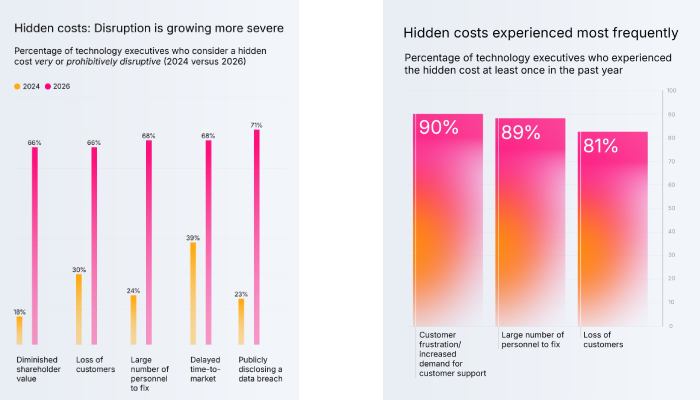
The impact of downtime extends far beyond direct financial loss. Organizations face a cascade of hidden costs that compound the crisis. Customer churn remains a major consequence, with 81% of technology leaders reporting loss of customers due to outages. Alarmingly, nearly half admit that customers are often the first to detect service disruptions highlighting gaps in monitoring and response capabilities.
At the same time, cybersecurity threats are intensifying the problem. Ransomware attacks have become significantly more expensive, with average payouts reaching $40 million, nearly tripling since 2024. Regulatory risks are also mounting, with fines averaging $51 million per organization, reflecting stricter compliance requirements and increasing scrutiny from regulators.
Operational strain is another critical dimension. Nearly 89% of organizations report needing large teams to resolve downtime incidents, while 90% experience surges in customer support demand. The burden extends beyond IT, affecting finance and marketing teams, and in many cases, damaging brand reputation. Nearly one in five marketing leaders report it can take an entire quarter to restore brand health after a major disruption.
A particularly concerning trend is the growing overlap between downtime and cybersecurity. The report reveals that 36% of security leaders say downtime is often misclassified as an IT issue, potentially giving attackers valuable time to exploit vulnerabilities. Furthermore, only 38% of organizations consistently identify the root cause of outages, compounding recovery challenges.
The increasing reliance on third-party platforms and SaaS solutions is further amplifying risk. The frequency of outages linked to these dependencies has nearly tripled since 2024, exposing the fragility of interconnected digital ecosystems. As organizations scale their digital transformation efforts especially across cloud and AI-driven environments the need for end-to-end visibility becomes critical.
Artificial Intelligence is emerging as both part of the problem and the solution. Enterprises are investing heavily a median of $24.5 million annually in AI tools to improve incident detection, triage, and response. Organizations that have mastered AI-driven workflows are significantly more resilient, with 74% avoiding public breach disclosures, compared to just 54% of less mature peers. They are also far less likely to lose customers.
However, AI adoption is not without risk. Every organization surveyed reported some form of AI-related downtime, and 68% of leaders expressed concerns about unpredictable AI behavior. This underscores the need for robust governance frameworks and human oversight, as enterprises transition toward increasingly autonomous systems.
To address these challenges, organizations are shifting their focus toward proactive resilience strategies. End-to-end observability has emerged as a top priority, with nearly all low-downtime organizations recognizing its importance. Investments are also being directed toward automation to reduce human error, which remains a leading cause of outages.
Ultimately, the research sends a clear message: resilience is no longer optional it is a competitive necessity. As digital ecosystems continue to expand, organizations must rethink how they monitor, secure, and sustain their operations in the face of constant disruption.
The $600 billion figure is more than a statistic it is a wake-up call. Businesses that fail to act risk not just downtime, but long-term erosion of trust, performance, and market position.
