


73% of UAE business leaders say their organizations are deploying AI beyond pilots, while 78% believe sovereignty strengthens security. Yet 64% have more technology pilots than they can realistically scale, highlighting the gap between experimentation and enterprise-wide execution.
The United Arab Emirates is moving into a more consequential phase of enterprise artificial intelligence adoption, with business leaders increasingly focused on the governance, security and operational control required to scale AI across critical business functions. Kyndryl’s third annual Readiness Report suggests that while organizations are advancing beyond experimentation, digital sovereignty is becoming a central consideration in decisions about infrastructure, data and technology partnerships.
The UAE findings, released on November 16, 2026, show that 73% of business leaders say their organizations are deploying AI in workflows beyond pilot projects. More than half, or 52%, significantly changed their AI strategy over the past year, compared with 48% globally. The figures indicate that AI is no longer being treated solely as an innovation initiative; it is increasingly influencing technology architecture, operating models and business priorities.
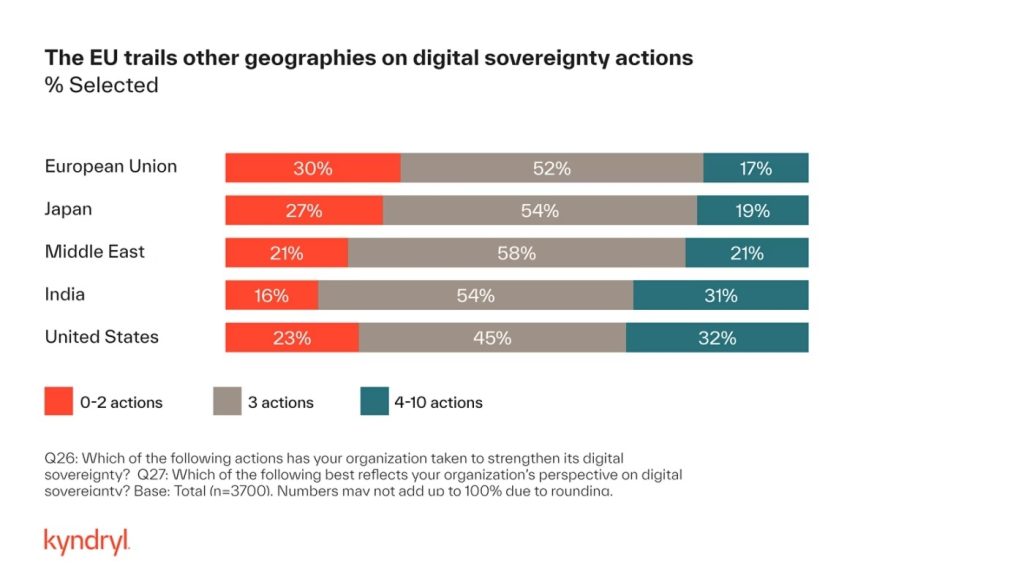
However, the report also identifies a significant scaling challenge. Although 73% say AI is being deployed beyond pilots, 51% still describe their organizations as being in the experimentation phase. Furthermore, 64% say they have more technology pilot projects than they can realistically scale. This suggests that adoption and operational maturity are not progressing at the same pace.
The research, based on responses from 3,700 senior business leaders across 21 countries, including 100 in the UAE, highlights a market balancing two priorities: accelerating AI deployment while maintaining control over the systems, information and infrastructure on which businesses increasingly depend.
Digital sovereignty becomes a business and security priority
One of the strongest findings is the growing value UAE leaders place on digital sovereignty. Nearly eight in ten respondents, or 78%, believe sovereignty requirements strengthen security by increasing control over critical systems. This is notably higher than the global figure of 69%.
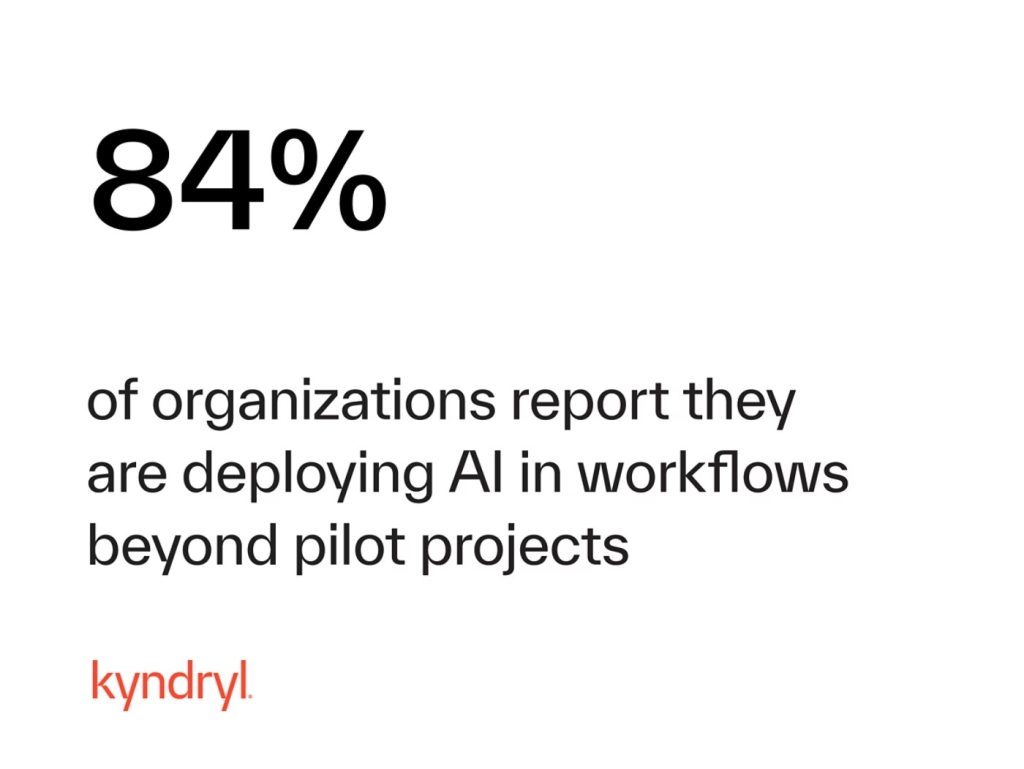
The willingness to invest in that control is also evident. Some 72% of UAE business leaders say full operational control over their technology is worth paying at least 10% more for, compared with 68% globally. This indicates that sovereignty is increasingly being viewed not simply as a regulatory or infrastructure requirement, but as a business consideration linked to resilience, security and continuity.
The preference for control, however, does not translate into a rejection of international technology providers. In fact, 73% of UAE respondents believe dependence on foreign technology providers is an acceptable risk that can be managed through contractual arrangements and safeguards. Globally, 61% share that view.
This is an important distinction. Digital sovereignty is often interpreted as a move towards complete technological independence or the replacement of foreign platforms with domestic alternatives. The Kyndryl findings suggest a more pragmatic approach among UAE business leaders. They want greater authority over data, systems and operations, while continuing to benefit from international technology capabilities.
For enterprises, the issue is therefore less about where a technology provider originates and more about the terms under which technology is deployed and managed. Data access, residency, security responsibilities, vendor dependencies, operational continuity and the ability to maintain control during disruption are becoming important elements of technology strategy.
“UAE business leaders are advancing AI adoption with a clear view of what they want to keep control of. Control and global partnerships are not in competition; organizations want the oversight to protect critical systems alongside the reach of a global technology ecosystem.”
— Maged Wassim, Vice President and Managing Director, Kyndryl MEA
Maged Wassim, Vice President and Managing Director, Kyndryl MEA, said UAE business leaders were advancing AI adoption while maintaining a clear understanding of the areas over which they needed control. He noted that the findings point to a model in which operational oversight and global technology partnerships can coexist.
Modern infrastructure provides a foundation, but scaling remains difficult
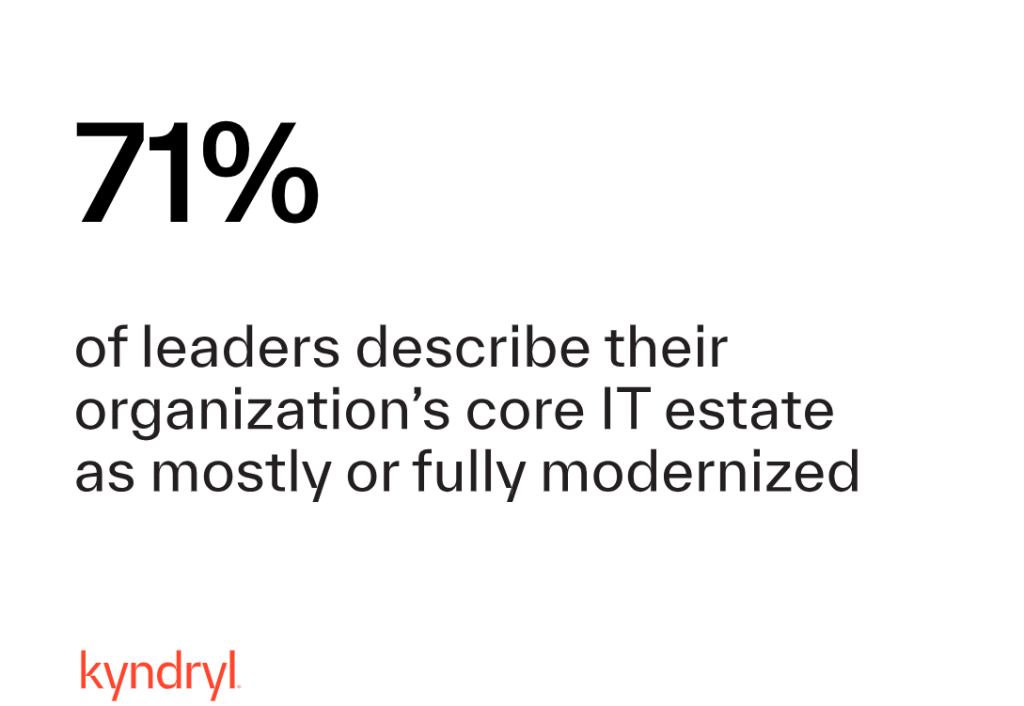
The UAE’s relatively modern technology estate provides a useful foundation for AI adoption. According to the report, 73% of business leaders describe their core IT environment as mostly or fully modernised, broadly in line with the global figure of 71%. Only 1% describe their technology environment as mostly legacy, compared with 5% globally.
Modern infrastructure can help organizations integrate data, applications and computing resources needed to support AI workloads. However, infrastructure modernisation alone does not guarantee that AI initiatives can be deployed consistently across business functions.
The gap between pilot activity and operational deployment remains a significant challenge. The fact that 64% of UAE leaders have more technology pilots than they can realistically scale points to issues that may include fragmented data environments, limited integration capabilities, governance requirements, skills shortages and difficulty demonstrating measurable returns.
Organizations may be able to establish successful AI use cases in individual departments, but replicating those outcomes across the enterprise requires more than deploying additional models or applications. It involves redesigning workflows, defining accountability, integrating AI with core systems and establishing controls for security, performance and responsible use.
The 52% of UAE respondents who significantly changed their AI strategy during the past year also reflects the pace at which the technology landscape is evolving. As new AI capabilities emerge, enterprises are reassessing investment priorities, infrastructure requirements and the balance between experimentation and long-term implementation.
The next stage will require organizations to establish clearer criteria for deciding which pilots should move into production, which should be redesigned and which should be discontinued. Without such discipline, growing pilot portfolios can consume resources without delivering corresponding business value.
Sovereignty is moving from strategy into operational practice
The report also examines how organizations are translating sovereignty priorities into practical measures. Among UAE respondents, 39% say their organizations have reviewed who can access sensitive data, while 37% have updated data governance policies to address residency requirements. Another 34% have evaluated the risks of vendor lock-in.
These actions indicate that sovereignty is extending beyond the physical location of data. It also involves who can access information, how data moves between systems, which parties manage critical infrastructure and whether organizations can retain operational control when technology providers or external conditions change.
For AI deployments, these questions become more complex. AI systems may rely on data distributed across cloud platforms, enterprise applications, model services and third-party tools. As organizations introduce AI agents capable of interacting with systems and executing tasks, access permissions and governance controls become especially important.
A business may have strong data residency arrangements but still face operational risks if it lacks visibility into how information is accessed or how automated systems act on it. Similarly, dependence on a technology provider may be manageable when contracts, service responsibilities, exit provisions and continuity arrangements are clearly defined.
The practical challenge for UAE enterprises is to build governance into technology architecture and daily operations rather than treating sovereignty as a separate compliance exercise. That includes regular reviews of access privileges, data flows, third-party dependencies and the ability to recover or continue operations if a provider or service becomes unavailable.
Resilience requires more than confidence
The report presents an interesting contrast between how UAE leaders perceive external risks and how prepared their organizations are to manage them.
Only 39% of UAE respondents express concern about cyberattacks, compared with 58% globally. On the surface, this could suggest a relatively confident business environment. However, average complete readiness across external risks stands at 25% in the UAE, close to the global figure of 24%.
The distinction between perceived risk and operational readiness is important. Lower concern does not necessarily mean stronger resilience. Organizations may feel confident about their security posture while still having gaps in incident response, recovery planning, third-party risk management or the protection of critical systems.
As AI becomes more deeply embedded in business operations, the consequences of disruption can also increase. A cyber incident affecting an AI-enabled workflow may interrupt customer services, financial processes, supply chains or internal decision-making. Organizations must therefore assess resilience not only at the infrastructure level but also across the business processes that depend on technology.
For technology leaders, this means aligning cybersecurity, business continuity, infrastructure modernisation and AI governance. The ability to detect threats, contain incidents, recover services and maintain control over critical data will be central to sustaining AI adoption.
The next phase: scaling AI with control and accountability
The Kyndryl findings point to a UAE enterprise market that is not choosing between AI innovation and digital sovereignty. Instead, business leaders increasingly see the two as interconnected. They want to use global technology ecosystems and advanced AI capabilities, but with stronger control over how critical systems operate and how sensitive information is protected.
The opportunity is substantial, but so is the execution challenge. Modernised infrastructure and growing AI deployment provide a foundation. Yet the high number of pilots that organizations cannot realistically scale suggests that many still need to address integration, skills, governance and operational readiness.
Enterprises that make progress will be those that connect AI investments to clear business outcomes, establish consistent governance frameworks and ensure that technology decisions preserve operational flexibility. Sovereignty should not become a barrier to innovation, just as AI adoption should not weaken control over critical systems.
Ultimately, the UAE’s next stage of digital transformation will depend on its ability to scale AI responsibly. That means moving beyond the number of pilots or models deployed and measuring whether AI improves productivity, strengthens resilience and delivers sustainable business value while keeping organizations firmly in control of their technology environments.
