

Rising data volumes and unpredictable AI behaviour are adding pressure to enterprise technology teams. While Saudi organizations report stronger vulnerability remediation, UAE businesses face a widening gap between observability investment and operational outcomes.
Artificial intelligence is expanding the volume and complexity of enterprise technology data across the Middle East, placing fresh pressure on organizations to rethink how they monitor, secure and manage increasingly autonomous systems. New findings from Dynatrace’s State of Observability 2026 report show that 46% of organizations surveyed in the UAE and 43% in Saudi Arabia say AI has increased the volume of telemetry data they manage, compared with 33% globally.
The findings point to two different stages of the observability challenge. In the UAE, organizations are struggling to translate observability capabilities into faster incident detection and resolution. In Saudi Arabia, reported outcomes are more balanced, particularly in vulnerability remediation and the transition of AI projects from pilot to production. Yet both markets face a common strategic question: can enterprises establish sufficient visibility and control as AI moves from experimentation into business-critical operations?
The issue is no longer limited to whether applications and infrastructure are available. AI systems can be operational and responsive while still producing inaccurate outputs, making poor decisions or behaving in ways that conflict with business requirements. As organizations deploy AI agents and large language models across enterprise workflows, conventional monitoring of system health is insufficient. Technology leaders increasingly need evidence of what AI systems are doing, why they are doing it, what resources they consume and what consequences follow.
The widening gap between AI ambition and operational control
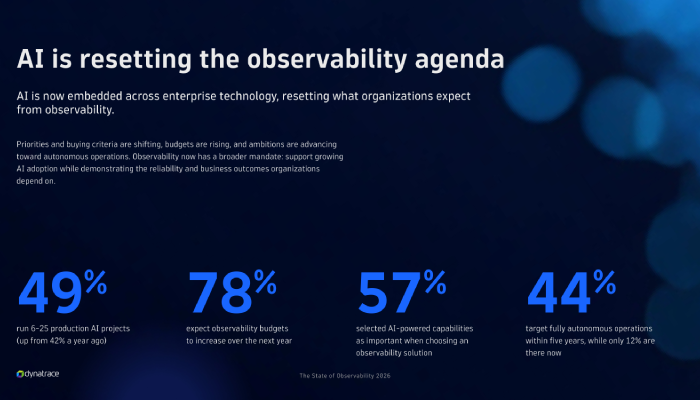
Dynatrace’s global research reveals the scale of the transition. Some 87% of respondents say their organizations use AI agents for observability and IT operations, while 44% aim to achieve fully autonomous operations within five years. Only 12% say they have reached that level today.
The gap between ambition and execution becomes clearer when organizations are asked how they validate AI decisions. Respondents say humans currently verify an average of 66% of AI-powered decisions. Yet only 27% say they address visibility into how AI agents make decisions and take actions. Across nine AI observability capabilities examined in the research, actual implementation trails perceived importance by an average of 14 percentage points.
This disparity matters because autonomy without adequate visibility can create operational and security risks. An AI agent may complete a task quickly but use an inappropriate data source, exceed its intended permissions or trigger an action that has unintended consequences. Without a reliable record of its decisions and interactions, organizations may struggle to investigate failures, establish accountability or demonstrate compliance.
The research therefore points to two complementary requirements. Observability of AI provides evidence about the quality, behaviour, security, cost and business impact of AI systems. AI-powered observability, meanwhile, uses causal analysis, automation and intelligent agents to improve the performance of the wider technology environment. The first helps establish whether AI is operating as intended; the second applies AI to make IT operations more efficient and increasingly autonomous.
“Organizations are moving towards autonomous operations, but the ability to verify how AI systems behave and make decisions is not keeping pace with their ambitions.”
UAE: Telemetry growth exposes an execution challenge
The UAE findings suggest that the rapid expansion of AI is adding pressure to already complex technology environments. Nearly half of respondents, 49%, say unpredictable AI application and model behaviour has increased complexity. Another 45% identify the management of multi-cloud and hybrid-cloud environments as a challenge.
The expansion of telemetry is also creating data-management demands. Around 40% cite the cost of storing, processing and retaining observability data, while an equal proportion point to the difficulty of integrating data from multiple sources. The growth of logs and telemetry, combined with AI workloads and fragmented infrastructure, is making it harder for technology teams to establish a consistent operational picture.
More concerning is the gap between investment in observability and the outcomes organizations report. Only 32% of UAE respondents say observability has helped them detect and resolve issues faster, compared with 52% globally and 48% across EMEA. Just 33% say it has helped accelerate AI projects from pilot to production, against 47% globally.
This suggests that simply collecting more telemetry does not necessarily produce better operational intelligence. Enterprises need to correlate information across applications, infrastructure, cloud environments and AI workloads to identify the underlying causes of disruption. Without that context, monitoring can generate more alerts and data without necessarily shortening the time required to resolve problems.
Security remediation presents another concern. Some 38% of UAE security respondents say their organizations miss their own targets for fixing critical vulnerabilities, the highest proportion among the 12 markets surveyed. Meanwhile, 31% report that it takes their organizations between one and four weeks on average to fully remediate a critical vulnerability, while 8% set remediation targets exceeding a month.
The figures highlight a potential mismatch between the speed at which organizations are adopting AI and the capacity of their operational and security teams to manage the resulting exposure. As AI becomes embedded in customer-facing and internal business processes, delayed vulnerability remediation can have consequences beyond the IT department.
Saudi Arabia: Stronger remediation, but data governance remains critical
Saudi Arabia presents a somewhat different picture. Although 43% of respondents say AI has increased telemetry volumes, only 25% believe it has made their overall technology environment more complex. This compares with 49% globally and 46% across EMEA.
However, the increase in monitoring requirements is evident: 43% say AI has increased the number of monitoring tools they need. The expansion of AI, large language models and agentic workloads is cited by 40% as a source of technology complexity.
The most distinctive challenge is the governance of sensitive and regulated information within observability pipelines. Some 37% identify this as a concern, compared with 31% globally. This reflects a fundamental tension: organizations need broad access to operational data to understand system behaviour, but that data can contain sensitive customer, employee or business information. Observability strategies must therefore balance visibility with data protection, access controls and regulatory obligations.
Saudi organizations report more encouraging outcomes in certain areas. Nearly 48% say observability has helped accelerate AI projects from pilot to production, slightly above the global figure of 47%. An equal proportion say it has supported better-informed business decisions, compared with 45% globally.
Security remediation is another relative strength. Some 35% of Saudi security respondents say their organizations fully remediate critical vulnerabilities within 24 hours on average, compared with 28% globally and 28% across EMEA. In addition, 40% report having a 24-hour remediation target, against 29% globally.
These findings indicate a stronger reported focus on rapid vulnerability management. Nevertheless, the 12% of Saudi respondents who set remediation targets exceeding a month underline that performance is not uniform across the market. Faster remediation must also be supported by accurate asset inventories, reliable vulnerability intelligence and the ability to distinguish exploitable exposure from lower-priority findings.
The economics and security of autonomous operations
The global research also suggests that observability is becoming a strategic investment rather than simply an IT monitoring expense. Some 78% of respondents expect observability budgets to increase, and among those anticipating growth, 96% say AI adoption is at least a moderate driver.
The complexity created by AI is a major factor. Some 43% identify the expansion of AI, LLM and agentic workloads as a leading source of technology complexity. At the same time, 55% of security respondents say their organizations experienced a zero-day incident during the previous year. These findings reinforce the need to connect operational telemetry with security intelligence and runtime evidence.
For organizations moving towards autonomous operations, visibility into AI decisions becomes especially important. The greater the authority delegated to agents, the stronger the requirements for validation, integration, governance and human oversight. Enterprises need to know not only whether an agent completed a task, but also whether it followed the correct policies, accessed appropriate information and produced the intended business outcome.
Open standards may help address some of the integration challenges. The report finds that 77% of organizations have moved OpenTelemetry beyond the evaluation stage, while 20% have adopted it as a strategic standard. Consistent telemetry practices can help organizations maintain visibility across cloud environments, applications and infrastructure, reducing dependence on fragmented monitoring systems.
From monitoring systems to evidence-led decisions
The strategic value of observability will increasingly depend on the quality of decisions it enables. Context-aware observability connects AI behaviour with the systems, risks, costs and business outcomes surrounding it. This gives technology leaders a stronger basis for deciding where AI is delivering sufficient value to expand, where greater autonomy is justified and where risk or cost requires intervention.
For UAE organizations, the priority is to convert expanding telemetry and observability investments into measurable improvements in incident resolution, AI deployment and vulnerability management. For Saudi organizations, the challenge is to build on stronger reported remediation outcomes while strengthening data governance and visibility across growing AI workloads.
Both markets are moving towards more AI-driven operations, but the next stage of adoption will demand more than additional monitoring tools or larger data pipelines. Enterprises will need reliable evidence of how systems and AI agents behave, how decisions are reached and what changes as a result.
The central lesson from Dynatrace’s research is that autonomy cannot be measured simply by the number of tasks delegated to AI. It must also be measured by an organization’s ability to understand, validate and govern those tasks. As AI scales across the enterprise, observability is becoming a foundation for operational trust, security and measurable business performance.
About the research: Dynatrace commissioned an online survey of 1,202 technology leaders at enterprises across 12 countries, including the UAE and Saudi Arabia, in August 2026. Results reflect respondents’ reports about their organizations. Percentages may not total 100% because of rounding or multiple-response questions. Further details are available in the full report methodology.
