


New Agent Hub capabilities, an Apple Ads action-taking agent and four MCP integrations bring greater transparency and human oversight to AI-powered marketing workflows.
AppsFlyer has expanded its agentic AI offering with capabilities that enable marketers to build custom AI agents, examine the reasoning behind recommendations and approve actions before execution. The announcement extends its Agent Hub, introduces its first agent capable of making changes directly within an advertising platform and adds four new Model Context Protocol (MCP) capabilities.
The expansion reflects a shift in enterprise marketing from using AI to generate insights towards deploying agents that can execute campaign-related tasks. However, as automation assumes a larger role, marketers need visibility into how decisions are reached and control over actions that affect advertising budgets and campaign performance.
The expanded Agent Hub allows marketers to create their own agents by describing a marketing performance workflow. These agents retrieve relevant event-level data, analyse performance and deliver scheduled insights through Slack or email. They can also conduct root-cause analysis and recommend actions, helping teams investigate fraud spikes, identify creative fatigue and evaluate campaign performance.
“Marketing teams are moving from manual campaign orchestration to agentic execution. With this release, AppsFlyer is giving marketers trusted, agentic tools that can analyse, recommend and act on their data to deliver clear value for growth.”
— Inna Weiner, VP Product, AppsFlyer
A key addition is the Apple Ads Share of Voice Agent, AppsFlyer’s first action-taking agent. It estimates share of voice across keywords and geographies, recommends bid adjustments when performance falls outside targets and can apply approved changes directly in Apple Ads. The agent is currently in closed beta and available through AppsFlyer customer success managers. Importantly, changes are made only after the marketer’s approval.
The four new MCP capabilities allow marketers to access AppsFlyer data through their preferred AI tools. Protect360 fraud data can be queried to identify fraud concentrations by geography and determine which custom validation rules are generating the most blocks. Creative-level performance data, covering spend, reach, conversions, retention and revenue, helps teams identify effective or declining advertising assets.
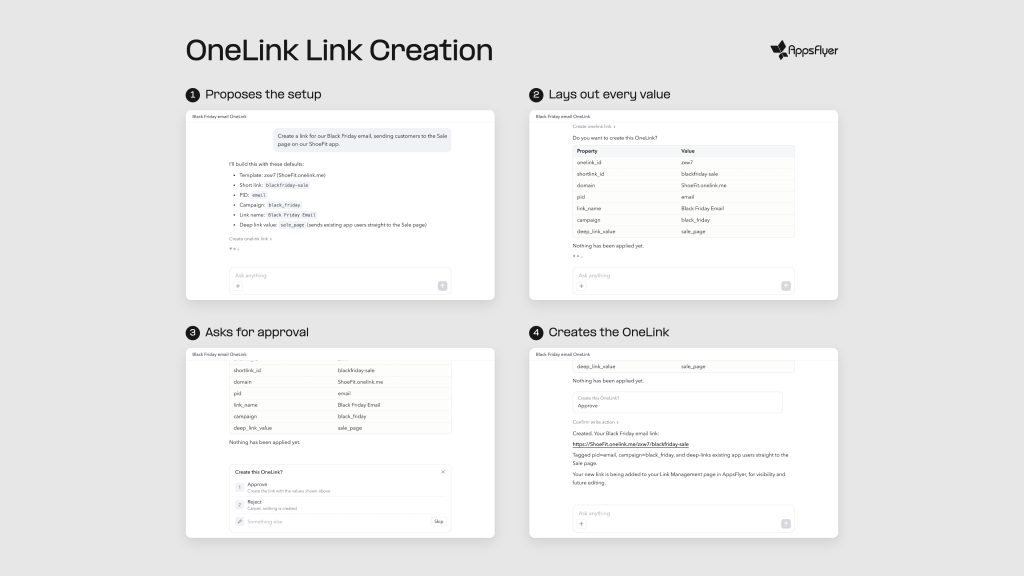
Two further capabilities address campaign creation and integration support. OneLink Link Creation converts plain-language campaign descriptions into configured campaign links, with creation subject to approval. Partner Integration Settings makes integration configurations, attribution windows, postback rules and event mappings accessible through MCP clients, helping marketing and support teams diagnose setup issues.
“Few markets have embraced AI with the conviction of the Gulf,” said Sarah Maina, Regional Manager, Middle East & France, AppsFlyer. She noted that the region’s growing gaming, fintech and e-commerce sectors are creating demand for agentic marketing capabilities. However, she emphasised that marketers need to understand the reasoning behind recommendations and approve actions before they are implemented. The new tools, she said, provide a foundation for scaling AI responsibly in line with the region’s broader ambitions.
The announcement underscores AppsFlyer’s focus on combining automation with transparency and human oversight as marketing teams move towards more autonomous workflows.
