

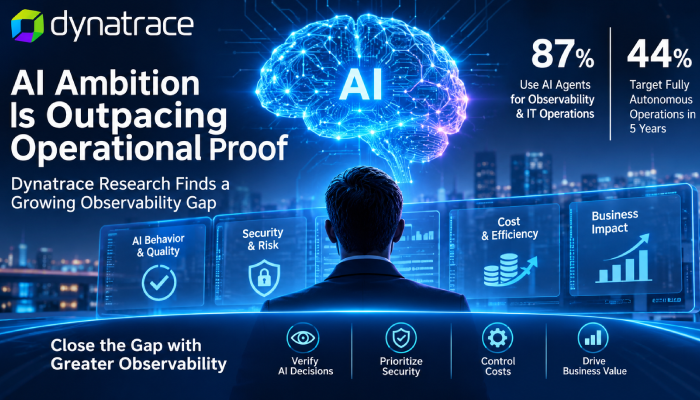
As enterprises move AI agents from experimentation into production, the ability to verify their decisions, measure business impact, control costs and contain security risks is becoming a critical test of operational resilience.
Artificial intelligence is moving deeper into enterprise operations, but organisations are struggling to establish whether their AI systems are consistently delivering the outcomes they expect. While businesses are increasing investment in AI agents and preparing for greater automation, the operational visibility needed to validate their behaviour, decisions and consequences is not advancing at the same pace.
This is the central finding of Dynatrace’s State of Observability 2026 research, which identifies a widening gap between enterprise AI ambition and the ability to govern AI in production. The study reveals that 87% of organisations now use AI agents for observability and IT operations. At the same time, 44% expect to achieve fully autonomous operations within five years, compared with just 12% that report having reached that level today.
The findings point to a fundamental challenge for technology leaders: deploying AI is becoming easier, but proving that it is operating correctly, securely and economically remains difficult.
The distinction matters because an AI system can be available, responsive and technically functional without necessarily producing accurate or appropriate results. Conventional IT monitoring can establish whether infrastructure is running, applications are responding and services are meeting performance thresholds. It may not establish whether an AI agent has made a sound decision, used reliable information, followed organisational policy or created the intended business outcome.
As AI becomes capable of initiating actions and influencing business processes, that gap moves from a technology concern to a governance and operational risk.
The autonomy ambition versus the reality of oversight
The adoption of AI agents in IT operations reflects growing confidence in their ability to identify anomalies, analyse operational data, recommend corrective actions and automate routine tasks. However, the research suggests that organisations are not yet ready to hand over substantial decision-making authority without human involvement.
Respondents say humans verify an average of 66% of AI-powered decisions. This indicates that human oversight remains a major part of enterprise AI operations, even as organisations plan to increase autonomy.
More significantly, only 27% currently address visibility into how AI agents make decisions and act, despite 43% considering this capability important. This gap raises questions about how enterprises will validate agent behaviour as these systems gain access to more applications, infrastructure and sensitive business processes.
The issue is not simply whether an agent reaches the right conclusion. Technology leaders also need to understand the information it used, the systems it interacted with, the sequence of actions it initiated and the consequences of those actions.
An agent that makes an incorrect recommendation can be stopped through human review. An autonomous agent with access to production systems, however, could potentially execute an inappropriate action before a human operator recognises the problem. Without sufficient visibility into its behaviour, identifying the cause and limiting the impact can become difficult.
The research indicates that the transition towards autonomy will therefore depend on more than improving AI models. It will require stronger integration, validation, explainability and operational controls.
AI observability remains behind business expectations
Dynatrace found that implementation trails perceived importance by an average of 14 percentage points across nine AI observability capabilities. This suggests that organisations understand the need for greater visibility but have not yet developed the operational mechanisms to deliver it consistently.
One of the most significant gaps concerns measuring the business impact of AI. While 39% of respondents consider this capability important, only 24% say their organisations currently address it.
This is an important distinction for enterprise decision-makers. AI initiatives are increasingly evaluated on their ability to improve productivity, reduce operational costs, accelerate decisions and create new revenue opportunities. Yet many organisations continue to assess AI through technical indicators or adoption levels rather than measurable business outcomes.
A model may generate responses quickly and an agent may complete a workflow, but these achievements do not automatically translate into business value. The organisation must determine whether the output is accurate, whether the action improves the process, whether the resources consumed are justified and whether the result complies with internal policies.
Observability of AI is intended to provide this evidence. It connects model behaviour with application performance, data quality, infrastructure dependencies, security exposure and business outcomes. This broader view can help leaders distinguish between AI that is merely operational and AI that is delivering measurable value.
“Organisations are preparing AI agents to do more before they can clearly establish how those agents reached a decision.” — Key finding from Dynatrace’s State of Observability 2026 research
AI is adding complexity and increasing infrastructure costs
The expansion of AI is also making enterprise technology environments more complex. Unlike traditional applications, AI workloads involve models, agents, data pipelines, inference services, external APIs and interactions with multiple enterprise systems.
The research identifies AI, large language models and agentic workload expansion as a leading source of technology complexity for 43% of respondents.
The financial implications are already visible. Some 81% report increased compute and infrastructure spending as a result of AI workloads, while 77% identify a greater need for cost-allocation visibility.
As organisations scale AI, infrastructure consumption can become difficult to attribute to specific applications, teams or business processes. Costs may arise from model inference, data retrieval, agent interactions, storage, network traffic and the underlying compute resources required to keep services available.
Without sufficient observability, technology leaders may struggle to determine which AI workloads are consuming the most resources, whether their performance justifies the expenditure and where optimisation is possible.
This is particularly relevant as agentic AI moves beyond isolated use cases. A single workflow may involve several agents, each calling models, retrieving information, executing code and interacting with databases or business applications. The resulting workload can create a chain of infrastructure and service dependencies that is difficult to assess through traditional monitoring tools.
AI-powered observability can help address this complexity by applying causal analysis, automation and AI agents to operational data. Rather than simply presenting alerts, it can help teams identify relationships between events, determine the underlying causes of disruptions and prioritise corrective action.
For enterprises, the objective is to connect infrastructure consumption with operational performance and business value. This can help determine which workloads deserve additional investment, where resources are being used inefficiently and which AI initiatives require tighter cost controls.
Security requires evidence from running environments
The growing use of AI also expands the enterprise attack surface. AI agents interact with applications, data stores, identities, APIs and infrastructure, creating additional connections that security teams must understand and protect.
Dynatrace’s research highlights the continuing challenge of identifying vulnerabilities that represent genuine operational exposure. Among security-qualified respondents, 55% experienced a zero-day incident during the previous year. However, only 45% say their organisations continuously monitor runtime environments for vulnerabilities that are actually exploitable or actively targeted.
The findings reinforce the limitations of relying exclusively on static vulnerability assessments. A vulnerability’s severity rating is important, but it does not necessarily establish whether the affected component is exposed, reachable or being targeted in a live environment.
Runtime evidence provides additional context. It can help security teams understand which vulnerable components are active, what systems they affect, how they connect to critical applications and whether an attacker could exploit those connections.
This becomes especially important in AI environments, where an exposed service or compromised identity may provide a route to systems and data used by agents. Security teams need to understand not only the vulnerabilities in individual components but also the relationships between infrastructure, applications, identities and data.
By correlating security information with runtime behaviour, organisations can prioritise remediation according to actual exposure and potential business impact. This can also help reduce the burden of responding to large volumes of vulnerability alerts without clear operational context.
Open standards are becoming essential for continuous visibility
Another important finding concerns the role of open standards in maintaining observability across increasingly distributed technology environments.
AI workloads can span multiple cloud providers, infrastructure platforms, development environments and production systems. As applications and models move between these environments, organisations need consistent instrumentation to preserve visibility into their behaviour.
OpenTelemetry is emerging as an important foundation for this purpose. The research found that 77% of respondents have moved OpenTelemetry beyond the evaluation stage, although only 20% have made it a strategic standard. Additionally, 37% identify AI and LLM workload observability as a leading driver of adoption.
Open standards can help organisations collect and maintain telemetry across different technologies without becoming overly dependent on a single vendor’s instrumentation approach. This is particularly relevant for enterprises operating hybrid and multi-cloud environments or using multiple AI providers.
However, collecting telemetry is only the first step. The information must also be interpreted in context. Organisations need to connect traces, metrics and logs with model behaviour, agent decisions, security events, resource consumption and business outcomes.
Without that correlation, even extensive telemetry may leave technology teams with fragmented views of what is happening across the enterprise.
A consistent instrumentation foundation can therefore support visibility from development through testing and into production, while giving organisations greater flexibility as their AI infrastructure evolves.
Observability of AI and AI-powered observability: two sides of resilience
Dynatrace’s research points to two complementary capabilities that technology leaders need to distinguish.
Observability of AI establishes evidence about how AI systems behave. It focuses on quality, reliability, decision-making, security, cost and business impact. It helps organisations determine whether models and agents are operating as intended and whether their outputs and actions meet expected standards.
AI-powered observability, in contrast, applies AI capabilities to improve the operation of the wider technology estate. Through causal analysis, automation and agent-based assistance, it can help identify problems, investigate dependencies and accelerate operational responses.
The two approaches address different but connected requirements. One provides the evidence needed to evaluate AI itself; the other uses AI to improve how people and systems manage technology operations.
This distinction will become increasingly important as organisations move towards greater autonomy. AI systems cannot be trusted with broader operational authority simply because they have performed well in a limited pilot. Their decisions must be evaluated against real-world conditions, operational policies and measurable outcomes.
The research also indicates that integration complexity is a significant barrier to greater autonomy, cited by 31% of respondents. Skills, oversight, data quality and explainability are additional constraints. These barriers suggest that organisations need to address the foundations of operational readiness rather than focus exclusively on deploying more capable agents.
From AI adoption to measurable operational accountability
The research presents a clear message for CIOs, CTOs, CISOs and other technology leaders: the next phase of enterprise AI will be defined less by how many agents an organisation deploys and more by how effectively it can understand, govern and measure their behaviour.
Three decisions will become particularly important. First, organisations must establish where AI is delivering sufficient value to justify expansion. Second, they must determine where agents can be given greater decision-making authority and where human approval remains necessary. Third, they need to identify where security exposure, operational risk or infrastructure costs require intervention.
These decisions require evidence that connects AI activity with the systems, data, risks and business processes surrounding it.
Dynatrace commissioned its online survey of 1,202 technology leaders at enterprises across 12 countries in August 2026. The findings reflect respondents’ reports about their organisations, with percentages subject to rounding and multiple-response questions where applicable.
The broader implication is that observability is evolving beyond its traditional role of monitoring infrastructure and application performance. As AI becomes embedded in enterprise operations, it is increasingly becoming a foundation for accountability, resilience and responsible automation.
The ambition to achieve autonomous operations is moving ahead rapidly. But autonomy without visibility can introduce new forms of operational uncertainty. Enterprises will need to establish not only that their AI systems are running, but also that they are making the right decisions, acting within acceptable boundaries and delivering outcomes that justify the investment.
In the AI era, the ability to prove that technology is working as intended may become as important as the ability to make it work in the first place.
