

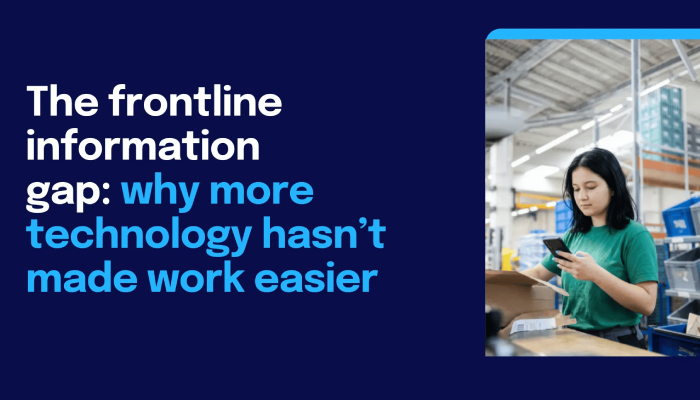
Staffbase study links fragmented workplace communication to lower productivity, more errors and slower decisions, highlighting the need to bring frontline employees into digital transformation.
As Gulf governments and businesses accelerate investment in artificial intelligence and digital transformation, a critical challenge remains: ensuring that the benefits reach employees working on the frontline. From airline crews and hotel supervisors to warehouse teams, healthcare workers and retail managers, employees who operate away from corporate offices often depend on fragmented communication channels and disconnected systems to perform their daily tasks.
New research commissioned by employee experience software provider Staffbase suggests that these information gaps can undermine operational efficiency and limit the value of digital investments. The study, conducted by Forrester Consulting, found that 48% of frontline workers and managers surveyed at US enterprises said information gaps reduced productivity or operational efficiency. Another 44% said these gaps increased the risk of errors or missed deadlines, while 43% reported slower decision-making. Only 23% felt fully supported by the information and tools available to do their jobs.
Although the survey was conducted among US employees rather than Gulf-based workers, its findings raise relevant questions for organisations across the Middle East, where national transformation programmes increasingly depend on frontline-heavy sectors such as logistics, transportation, tourism, hospitality and healthcare.
The UAE National Strategy for Artificial Intelligence 2031 identifies several of these sectors as priorities for AI adoption. Saudi Arabia, meanwhile, is expanding its tourism industry as part of Vision 2030, with the sector having generated more than one million jobs by August 2025, according to the Kingdom’s Minister of Tourism.
Much of the work underpinning these ambitions happens outside traditional office environments. Employees operate across airports, hotels, hospitals, retail outlets, warehouses and industrial facilities, often across multiple shifts, locations and languages. For these workers, access to accurate, timely and relevant information can be as important as the technology being deployed.
The last mile of digital transformation
For organisations investing in AI, cloud platforms and enterprise applications, the challenge is increasingly about connecting technology with everyday employee activity. Digital tools may be available at headquarters, but their value diminishes if frontline employees cannot easily access the information or guidance needed to make decisions.
“In the Gulf, transformation is often government-led, and the leaders delivering it feel personally accountable for whether it lands,” said Conor Duffy, Regional Leader, Middle East, at Staffbase.
He noted that launching a platform at head office is different from ensuring that a cabin crew member or store manager can find reliable information immediately before a shift. The business value of digital investment, he argued, depends on whether employees can access and act on the right information when they need it.
This gap between technology deployment and employee adoption is particularly important as organisations introduce AI into operational processes. An AI assistant may be able to answer questions, summarise procedures or recommend next steps, but it cannot reliably support employees if the underlying information is incomplete, inconsistent or outdated.
The problem begins with how information is distributed. In the Forrester study, more than half of respondents said they received critical company news and information through six or more channels. Meanwhile, 35% encountered conflicting, outdated or unclear information a few times a week or more.
“AI can give people the wrong answer faster if the content behind it is outdated or contradictory.” — Conor Duffy, Regional Leader, Middle East, Staffbase
When employees cannot find a definitive answer, they often turn to colleagues or managers. Some 42% of respondents said they sought clarification from coworkers or managers when information was missing or unclear. Although this informal support can help resolve immediate problems, it also consumes time, creates dependency on individual knowledge and increases the risk of inconsistent decisions.
For frontline teams, the consequences can extend beyond productivity. A delayed safety notice, an outdated operating procedure or a food-safety alert that fails to reach every employee could create operational and compliance risks. In environments where workers have limited time to consult multiple systems, information must be easy to locate, current and understandable.
Fragmented systems undermine employee productivity
The study points to demand for a more integrated employee experience. Eighty-three percent of respondents said a single application combining work activities and information would have a high or very high impact on their ability to do their jobs.
The finding suggests that frontline employees do not necessarily need more applications. They need simpler access to the tools, information and tasks already spread across their organisation’s technology environment.
Staffbase describes this challenge as the “last mile” between business technology and the employee. Its approach is to consolidate services where practical and connect systems that need to remain separate, enabling employees to access communications, trusted information and everyday tasks through a common interface without requiring organisations to replace all their existing platforms.
The company cites the example of a Gulf-based international airline using Staffbase to reach more than 25,000 employees, most of whom work onboard aircraft or at airport gates rather than at desks. The case illustrates the difficulty of maintaining consistent communication across a geographically distributed workforce whose members may have limited access to traditional corporate channels.
Globally, DHL Group uses Staffbase to connect 600,000 employees, including 300,000 who previously lacked intranet access. The platform is available in 81 interface languages, addressing one of the practical challenges facing multinational organisations: ensuring that employees across different countries and language groups can access workplace information.
Such deployments highlight the role of employee communication platforms in supporting operational consistency. However, success depends not simply on providing mobile access, but also on ensuring that the information delivered is relevant to each employee’s role, location and responsibilities.
For Gulf organisations managing diverse workforces, language support and mobile-first access can be especially important. A digital workplace designed primarily around office-based employees may fail to meet the needs of workers who spend their shifts moving between sites, serving customers or operating equipment.
AI adoption brings new opportunities—and new risks
The research also points to growing employee interest in AI-powered workplace assistance. Forty-seven percent of respondents ranked AI-powered answers and guidance among the three capabilities they most wanted, while 46% prioritised a single place to view tasks and next steps.
These preferences indicate that employees see potential value in AI when it helps them find information, understand what needs to be done and complete work with fewer interruptions. For a frontline manager, for example, an AI assistant could help locate a current operating procedure or clarify a policy without requiring a search across multiple systems.
But deploying such capabilities also creates governance challenges. Staffbase notes that employee AI use is distributed across separate tools, creating opportunities for shadow AI—the use of AI applications outside formal organisational oversight—and introducing potential cybersecurity, privacy and compliance risks.
When employees rely on unauthorised tools to summarise documents, draft responses or retrieve information, organisations may lose visibility into how business data is being processed. The risks become more pronounced if sensitive information is entered into tools that have not been assessed or approved by the organisation.
The reliability of AI-generated answers presents another concern. An assistant may provide a confident response based on outdated policies, contradictory documents or incomplete information. For employees making operational decisions, the speed of an incorrect answer can amplify rather than solve the original problem.
This makes information governance a prerequisite for effective workplace AI. Organisations need to establish clear ownership of internal content, remove obsolete material, resolve conflicting guidance and define which sources AI systems are authorised to use. Access controls must also ensure that employees receive only information appropriate to their roles.
A regional insurer operating across 12 countries uses Staffbase to give frontline employees access to everyday documents and procedures, whether they are working remotely or at a desk. As the organisation expands its use of AI, the same trusted content can provide the foundation for AI-powered assistance.
The example illustrates an important principle: AI adoption is not only a technology challenge. It also depends on the quality, accessibility and governance of the information that employees and AI systems use.
Preparing the frontline for 2027
For organisations planning their 2027 digital transformation programmes, Staffbase recommends designing employee experiences around the needs of the hardest-to-reach workers rather than adapting office-centric systems as an afterthought.
That means providing mobile-friendly access, supporting local languages, simplifying the route to essential information and offering hands-on assistance during implementation. Organisations should also plan employee adoption from the outset, rather than measuring success solely by the number of licences deployed or applications launched.
Equally important is establishing governance before introducing AI assistants at scale. Businesses need to determine which information sources are authoritative, who is responsible for maintaining them and how changes are reflected in AI-generated guidance. Monitoring and feedback mechanisms can help identify incorrect answers and improve the reliability of the system over time.
“More frontline employees will soon ask an AI assistant before they ask their manager,” Duffy said. “If the content behind it is outdated or contradictory, AI can give people the wrong answer faster.”
His warning captures the tension facing organisations across the Gulf. Significant investments in digital infrastructure and AI may create new capabilities, but those capabilities will not automatically translate into better operational outcomes. Employees must be able to access the right information, trust it and act on it.
The Forrester Opportunity Snapshot, titled The Frontline Experience in 2027: Closing the Information Gap, is based on a custom survey of 189 frontline workers and managers at US enterprises in retail, healthcare, manufacturing and materials, and transportation and logistics. The survey was conducted in August 2026. Its findings should not be interpreted as direct measurements of frontline experience across the Gulf, but they offer a useful indication of the operational challenges that organisations may need to address as AI adoption expands.
For Gulf businesses, the next stage of transformation will require more than deploying AI tools or modernising back-end systems. It will require connecting those investments to the people responsible for delivering services, serving customers and keeping operations running. The organisations that bridge this gap are better positioned to turn digital investment into measurable productivity, stronger compliance and more consistent execution.
