

Denodo Study Highlights Growing ‘Trust Gap’ Threatening Agentic AI Adoption
Denodo has unveiled findings from its latest global research, The AI Trust Gap Report, revealing a significant challenge confronting enterprises as they transition toward agentic AI. Based on insights from 850 executives worldwide, the study finds that while organizations are eager to embrace AI systems capable of autonomous decision-making, a lack of trust in underlying data is slowing adoption.
The report underscores a critical reality: as AI evolves from passive tools that generate insights to active systems that execute decisions, the margin for error dramatically shrinks. Agentic AI systems, which can independently trigger workflows and business outcomes, demand data that is not only accurate but also real-time, contextual, and governed. However, most organizations are struggling to meet these requirements.
One of the most pressing concerns highlighted in the study is the need for real-time data. Nearly 66% of respondents indicated that access to real-time data is non-negotiable for trusting AI-driven outcomes. Without it, enterprises risk making decisions based on outdated or incomplete information an unacceptable scenario when AI systems are directly influencing operations.
“When an AI agent triggers a business outcome, there is zero room for stale or ungoverned data.” – Dominic Sartorio
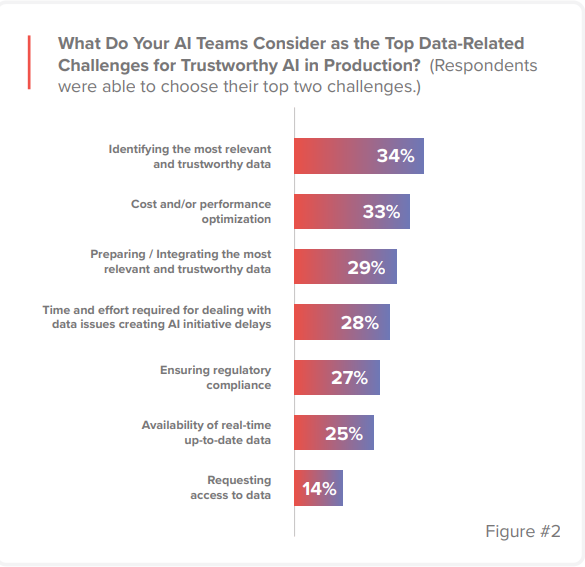
Closely tied to this is the challenge of finding relevant data within specific business contexts. About 63% of organizations reported difficulties in identifying and accessing the right data for AI deployment. This issue is compounded by the sheer scale and complexity of enterprise data environments. On average, AI initiatives now draw from more than 400 data sources, while one in five organizations manage over 1,000 sources. Such fragmentation creates silos that hinder the seamless flow of information required for effective AI execution.
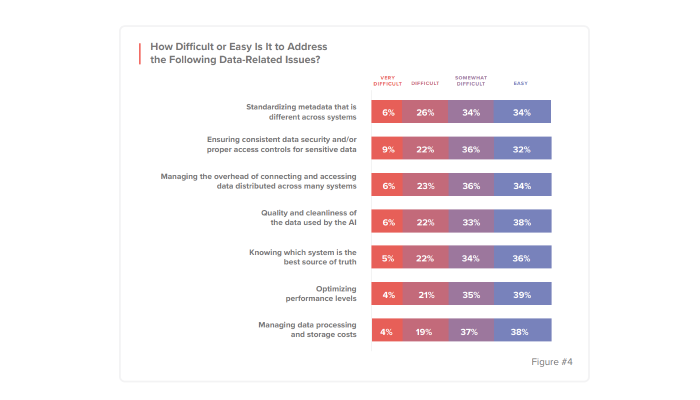
Security and governance present another major hurdle. Around 67% of respondents struggle to maintain consistent security policies and access controls across disparate systems. In the context of agentic AI, where systems can autonomously act on data, inconsistent governance frameworks pose significant risks, including unauthorized access and compliance failures.
Performance challenges further complicate the picture. Nearly 60% of organizations reported difficulties in optimizing systems to handle the intensive workloads associated with large-scale AI deployments. This not only impacts efficiency but also delays the transition from pilot projects to full-scale implementation.
According to the report, the so-called “trust gap” is not rooted in the capabilities of AI models themselves but in the data architectures that support them. Legacy systems, fragmented data pipelines, and static data repositories are ill-suited for the dynamic, real-time needs of agentic AI.
The findings make it clear that organizations must rethink their data strategies to unlock the full potential of AI. Moving beyond traditional data silos toward integrated, governed, and real-time data ecosystems will be essential. Without this shift, enterprises risk being stuck in a cycle of experimentation, unable to scale AI initiatives into meaningful business outcomes.
As agentic AI continues to gain momentum, bridging this trust gap will be critical. Enterprises that invest in modern data foundations today will be better positioned to harness the power of autonomous AI systems turning insights into action with confidence and speed.
